Appendix 3 Materials Related to Objections and Appeals
ICANN Procedures
ICANN Objection Procedure
This Procedure applies to all proceedings administered by each of the Dispute Resolution Service Providers (DRSPs). Each of the DRSPs has a specific set of rules that will also apply to such proceedings.
Article 1. ICANN’s New gTLD Program: 2026 Round
The Internet Corporation for Assigned Names and Numbers (ICANN) has implemented a Program for the introduction of new generic Top-Level Domain Names (gTLDs) in the Internet.
The New gTLD Program: 2026 Round includes this Objection Procedure (the Procedure), pursuant to which disputes between an entity that applies for a new gTLD, or a primary gTLD and allocatable variant strings, and a person or entity that objects to that/those gTLD(s), are resolved.
Dispute resolution proceedings shall be administered by a Dispute Resolution Service Provider (DRSP) in accordance with this Procedure and the applicable DRSP Rules that are identified in Article 4(b).
DRSPs shall adhere to ICANN’s Code of Conduct and Conflict of Interest Guidelines for Service Providers (Appendix 8) and ICANN’s Conflicts of Interest policy (Appendix 7).
By filing an Application or an Objection, an Applicant or Objector respectively accept the applicability of this Procedure, the 2026 Round Applicant Guidebook, and the applicable DRSP’s Rules that are identified in Article 4(b). The Parties cannot deviate from this Procedure without the express approval of ICANN and from the applicable DRSP Rules without the express approval of the relevant DRSP.
Article 2. Definitions
The “Objector” is one or more persons or entities that have filed an Objection against an Application.
The “Respondent” is an Applicant that responds to an Objection.
The “Parties” are the Objector and the Respondent.
The “Panel” is a group consisting of one or three persons empaneled by a DRSP in accordance with this Procedure and the applicable DRSP Rules that are identified in Article 4(b) to adjudicate on an Objection.
The “Panel Determination” is the decision issued by a Panel on an Objection that is rendered in a proceeding conducted under this Procedure and the applicable DRSP Rules that are identified in Article 4(b).
The grounds upon which an Objection to a new gTLD may be filed, as set out in Section 4.1 Objections and Appeals of the Applicant Guidebook, are:
String Confusion;
Legal Rights;
Limited Public Interest; and
Community.
“DRSP Rules” are the additional rules of procedure of a particular DRSP that have been identified as being applicable to Objection proceedings under this Procedure.
Article 3. Dispute Resolution Service Providers
The various categories of disputes shall be administered by the following DRSPs:
String Confusion and Legal Rights Objections shall be administered by the World Intellectual Property Organization.
Limited Public Interest and Community Objections shall be administered by the International Chamber of Commerce.
Article 4. Applicable Rules
All proceedings before the Panel shall be governed by this Procedure and by the DRSP Rules that apply to a particular category of Objection. The outcome of the proceedings shall be deemed a Panel Determination, and the members of the Panel shall act as panelists.
The applicable DRSP Rules are the following:
For a String Confusion Objection, the applicable DRSP Rules are posted on this webpage: https://www.wipo.int/amc/en/domains/sco/.
For a Legal Rights Objection, the applicable DRSP Rules are posted on this webpage: https://www.wipo.int/amc/en/domains/lro/.
For a Limited Public Interest Objection, the applicable DRSP Rules are posted on this webpage: https://iccwbo.org/dispute-resolution/dispute-resolution-services/adr/icann-new-gtld-dispute-resolution//.
For a Community Objection, the applicable DRSP Rules are posted on this webpage: https://iccwbo.org/dispute-resolution/dispute-resolution-services/adr/icann-new-gtld-dispute-resolution/.
In the event of any discrepancy between this Procedure and the applicable DRSP Rules, this Procedure shall prevail.
The place of the proceedings, if relevant, shall be the location of the DRSP that is administering the proceedings.
In all cases, the Panel shall ensure that the Parties are treated equally in that each Party is given a reasonable opportunity to present its position.
Article 5. Language
The language of all submissions and proceedings under this Procedure shall be English.
Parties may submit supporting evidence in its original language, provided and subject to the authority of the Panel to determine otherwise, that such evidence is accompanied by a certified or otherwise official English translation of all relevant text.
Article 6. Communications and Time Limits
All communications must be submitted electronically as specified in the DRSP Rules. A Party that wishes to make a submission that is not available in electronic form (e.g., evidentiary models) shall request leave from the Panel to do so, and the Panel, in its sole discretion, shall determine whether to accept the non-electronic submission. In limited circumstances and if permitted by the DRSP, a Party may make a call with the DRSP to clarify administrative matters. Virtual hearings will only be allowed upon request of the Panel.
The DRSP, Panel, Objector, and Respondent shall provide virtual copies to one another of all correspondence (apart from confidential correspondence between the Panel and the DRSP and among the Panel) regarding the proceedings.
For the purpose of determining the date of commencement of a time limit, a notice or other communication shall be deemed to have been received on the day that it is transmitted in accordance with paragraphs (a) and (b) of this Article.
For the purpose of determining compliance with a time limit, a notice or other communication shall be deemed to have been sent, made or transmitted if it is dispatched in accordance with paragraphs (a) and (b) of this Article prior to or on the day of the expiration of the time limit.
For the purpose of calculating a period of time under this Procedure, such period shall begin to run on the day following the day when a notice or other communication is received.
Unless otherwise stated, all time periods provided in the Procedure are calculated on the basis of calendar days.
Article 7. Filing of the Objection
A person or entity wishing to object to an application for a new gTLD may file an Objection, subject to standing requirements set out below. Any Objection to a proposed new gTLD must be filed before the published closing date for the applicable Objection Filing period.
The Objection must be filed with the appropriate DRSP as follows:
A String Confusion Objection must be filed at https://www.wipo.int/amc/en/domains/sco/.
A Legal Rights Objection must be filed at https://www.wipo.int/amc/en/domains/lro/.
A Limited Public Interest and a Community Objection must be filed at https://iccwbo.org/dispute-resolution/dispute-resolution-services/adr/icann-new-gtld-dispute-resolution/how-to-file-an-objection/.
Objections must be filed as follows:
An Objector that wishes to object to an application on more than one ground must file separate Objections with the appropriate DRSP(s).
An Objector who wishes to object to more than one application must file separate Objections to each application with the appropriate DRSP(s).
Should a Party with standing wish to file a String Confusion Objection against an application for a string for which several applicants have applied, it may file an Objection against one, some, or all applications for that string. In such a case, the string confusion DRSP may introduce a differential fee structure. If the Objection is filed against several applications for an identical string, the Applicant for each application receiving an Objection may file a response to the Objection; if the Applicant fails to file a response, the Objection will be upheld against those applications. The same Panel will review all documentation associated with the Objection, and each response will be reviewed on its own merits. The Panel will issue a single determination identifying which applications are in contention, where applicable.
Objections may be filed when ICANN announces the opening of an Objection window during the following time periods:
For 104 days, for all Objection grounds, starting on String Confirmation Day.
For 30 days, for String Confusion only, following the publication of updated contention sets once String Evaluation has been completed.
For 30 days, for all Objections grounds, in case of .Brand String Change, starting on the day the String Evaluation Reports are published, and only if the string evaluation is successful.
Article 8. Content of the Objection
The Objection shall contain, at a minimum, the following information:
The names and contact information (address, telephone number, email address, etc.) of the Objector;
A statement of the Objector’s basis for standing; and
A description of the basis for the Objection, including:
A statement of the ground upon which the Objection is being filed, as stated in Article 2(f) of this Procedure;
An explanation of the validity of the Objection and why the Objection should be upheld.
The substantive portion of the Objection shall be limited to 5,000 words, excluding attachments. Attachments are not a method to provide additional arguments or evade or circumvent the prescribed word limit. The Objector shall also describe and provide copies of any supporting or official documents upon which the Objection is based.
At the same time as the Objection is filed, the Objector shall pay a filing fee in the amount set in accordance with the applicable DRSP Rules and include evidence of such payment along with the Objection. In the event that the filing fee is not paid within 10 days of the transmission of the Objection to the DRSP, the Objection shall be dismissed without prejudice.
Article 9. Administrative Review of the Objection
The DRSP shall conduct an administrative review of the Objection for the purpose of verifying compliance with Articles 5-8 of this Procedure and the applicable DRSP Rules, and inform ICANN of the result of its review within 14 days of its transmission of the Objection and the filing fee. The DRSP may extend this time limit for reasons explained in the notification of such extension. The administrative review includes the determination whether the Objection was filed with the correct DRSP.
If the DRSP finds that the Objection complies with Articles 5-8 of this Procedure and the applicable DRSP Rules, the DRSP shall confirm that the Objection shall be registered for processing.
If the DRSP finds that the Objection does not comply with Articles 5-8 of this Procedure and the applicable DRSP Rules, the DRSP shall have the discretion to request that any administrative deficiencies in the Objection be corrected within five days of the Objector receiving the request from the DRSP. If the deficiencies in the Objection are cured within the specified period but after the lapse of the time limit for submitting an Objection stipulated by Article 7(e) of this Procedure, the Objection shall be deemed to be within this time limit.
If the DRSP finds that the Objection does not comply with Articles 5-8 of this Procedure and the applicable DRSP Rules, and the deficiencies in the Objection are not corrected within the period specified in Article 9(c), the DRSP shall dismiss the Objection and close the proceedings, without prejudice to the Objector’s submission of a new Objection that complies with this Procedure, provided that the Objection is filed within the deadline for filing such Objections. The DRSP’s review of the Objection shall not interrupt the running of the time limit for submitting an Objection stipulated by Article 7(e) of this Procedure.
Upon registering an Objection for processing, pursuant to Article 9(b), the DRSP shall post the following information about the Objection on its website: (i) the proposed application and string to which the Objection is directed; (ii) the names of the Objector and the Applicant; (ii) the grounds for the Objection; and (iv) the dates of the DRSP’s transmission of the Objection.
Article 10. Notification
Within 30 days of the deadline for filing Objections in relation to gTLD applications in a given round, ICANN shall publish on its website all of the admissible Objections that have been filed (the Objection Announcement). ICANN shall also directly inform each DRSP of the posting of the Objection Announcement.
Upon publication of the Objection Announcement, each DRSP shall promptly send a notice to the respective: (i) Objector(s); and (ii) each Applicant with an application to which one or more registered Objections have been filed (Respondent) with that DRSP, that is, those that have passed the Administrative Review.
Article 11. Consolidation of Objections
Any Applicant or Objector may propose the consolidation of certain Objections within seven days of the publication of the Objection Announcement.
The DRSP, at its discretion, may elect to propose the consolidation of certain objections within 14 days of the publication of the Objection Announcement, weighing the benefits (in terms of time, cost, consistency of decisions, etc.) that may result from the consolidation against the possible prejudice or inconvenience that the consolidation may cause.
In the case of String Confusion, Objections against Applications that are in direct contention may be consolidated and a single Panel Determination will be issued explaining the contention. Objections based upon different grounds, as summarized in Article 2(f), shall not be consolidated.
In case the DRSP proposes the consolidation of certain Objections, the Parties shall have seven days after receiving the notice to submit any concerns to the DRSP about the proposed consolidation.
The DRSP shall inform the Parties of its final decision of consolidation (Notice of Consolidation) within 28 days of the Objection Announcement.
Article 12. Appointment of The Panel
The DRSP shall select and appoint the Panel within 40 days after the publication of the Objection Announcement or, where applicable, the Notice of Consolidation, and issue a Panel appointment notice to the Parties.
The default will be a one-person Panel, unless the Parties to the proceeding mutually agree upon a three-person Panel. The Parties will have to notify the DRSP via a joint letter within 10 days of the publication of the Objection Announcement or, where applicable, the Notice of Consolidation, should they wish to have a three-person Panel.
Specific qualifications of Panelist(s):
In proceedings involving a String Confusion Objection, the Panelist(s) should have experience in Legal Rights disputes; at least one of the Panelists should have knowledge of the relevant script(s).
In proceedings involving a Legal Rights Objection, the Panelist(s) should have experience in Legal Rights disputes.
In proceedings involving a Limited Public Interest Objection, the Panelist(s) should be recognized as eminent jurists of international reputation, with expertise in relevant fields as appropriate; these may include, but are not limited to, social sciences, political science, sociology, health sciences, and others.
In proceedings involving a Community Objection, the Panelist(s) should be recognized as eminent jurists of international reputation, with expertise in relevant fields as appropriate; these may include, but are not limited to, social sciences, political science, sociology, and others. At least one of the Panelists should ideally have understanding or knowledge of the relevant community.
All Panelists acting under this Procedure shall be impartial and independent of the Parties. The applicable DRSP Rules stipulate the manner by which each Panelist shall confirm and maintain their impartiality and independence.
Unless required by a court of law or authorized in writing by the Parties, a Panelist shall not act in any capacity whatsoever, in any pending or future proceedings, whether judicial, arbitral or otherwise, relating to the matter referred to Panel Determination under this Procedure.
In cases where there may be indirect contention that results from a String Confusion Objection, the same Panel will ideally preside over decisions relating to each relevant Objection. For example, if Party X files an Objection against “String A” claiming that it is similar to Party X’s applied-for “String B”, and Party Y files an Objection against “String B” claiming that it is similar to its applied-for “String C”, the same Panel will ideally have to precede over both determination, as a potential result is that “String A” and “String C” are in direct contention with “String B” and indirect contention with each other (String A → String B ← String C).
The DRSP Rules will establish the procedures to raise and address conflicts of interest concerns with the assigned panel.
Article 13. Quick Look Review
Each Panel shall conduct the Quick Look Review of the Objection for the purpose of identifying and eliminating Objections that are manifestly unfounded, an abuse of the right to object, or both.
The criteria the Panel will use to determine whether the Objection is manifestly unfounded, an abuse of the right to object, or both are the following:
The Objection is not filed on one of the accepted Objection grounds.
The Party filing the Objection does not have standing.
Insufficient or no evidence is provided to support the Objection.
The Objection is far-fetched, clearly invented, manifestly contrary to common sense, or so ambiguous that it is objectively impossible for the DRSP to make sense of it.
The Objection spreads, incites, promotes, or justifies hatred based on intolerance towards a certain group.
Multiple Objections on the same ground are filed by the same or affiliated Parties against the same Applicant in a manner that constitutes harassment of the Applicant.
Other facts that may clearly show that the Objection is manifestly unfounded and/or an abuse of the right to object.
The Quick Look Review must be completed within 30 days of the Panel appointment or conflict mitigation, should conflicts of interest issues be raised by the parties.
The dismissal of an Objection that is manifestly unfounded, an abuse of the right to object, or both would be a Panel Determination, rendered in accordance with Article 22 of the Objection Procedure.
The DRSPs will publish the results of the Quick Look Review on their respective websites and notify the respective Applicants and Objector(s) and Respondent(s) of said results.
Article 14. Costs
Each DRSP shall determine the costs for the proceedings that it administers under this Procedure in accordance with the applicable DRSP Rules. Such costs shall cover the fees and expenses of the members of the Panel, as well as the administrative fees of the DRSP (the Costs).
Within 10 days of completing the Quick Look Review, the DRSP shall estimate the total Costs of an Objection proceeding and request each Party to pay, in advance, the full amount of the estimated Costs to the DRSP. If the Parties agree on a three-person Panel, the Costs of the dispute will increase.
Each Party shall make its advance payment of Costs within 20 days of the notification of the outcome of the Quick Look Review and submit to the DRSP evidence of such payment. The DRSP may revise its estimate of the total Costs and request additional payments from the Parties during the proceedings.
Failure to make an advance payment of Costs shall lead to the DRSP issuing a procedural Determination as follows:
If the Objector fails to make the advance payment of Costs, its Objection shall be dismissed and no fees that it has paid shall be refunded.
If the Respondent fails to make the advance payment of Costs, the Objection will be deemed to have been sustained and no fees that the Respondent has paid shall be refunded.
If both Parties fail to make the advance payment of costs, the Objection shall be dismissed and no fees that the Objector and Respondent have paid shall be refunded.
Upon the termination of the proceedings, after issuance of the Panel Determination, the DRSP shall refund to the prevailing Party, as determined by the Panel, its advance payment(s) of Costs.
Article 15. Response to the Objection
The Respondent shall file a Response to each Objection (the Response) within 30 days of being informed of the results of the Quick Look Review pursuant to Article 13(e).
The Response must be filed with the appropriate DRSP, using a model form made available by that DRSP, with copies to the Objector.
The Response shall contain, at a minimum, the following information:
The names and contact information (address, telephone number, email address, etc.) of the Respondent; and
A point-by-point Response to the statements made in the Objection.
The substantive portion of the Response shall be limited to 5,000 words, excluding attachments. Attachments are not a method to provide additional arguments or evade or circumvent the prescribed word limit. The Respondent shall also describe and provide copies of any supporting or official documents to the DRSP upon which the Response is based.
At the same time as the Response is filed, the Respondent shall pay a filing fee in the amount set and published by the relevant DRSP (which shall be the same as the filing fee paid by the Objector) and include evidence of such payment in the Response. In the event that the filing fee is not paid within 20 days of the notification of the outcome of the Quick Look Review, the Respondent shall be deemed to be in default, any Response disregarded, the Objection shall be deemed successful, and the DRSP shall issue a procedural Determination.
If the DRSP finds that the Response does not comply with Articles 15(c) and (d) of this Procedure and the applicable DRSP Rules, the DRSP shall have the discretion to request that any administrative deficiencies in the Response be corrected within five days of the Respondent receiving the request from the DRSP. If the administrative deficiencies in the Response are cured within the specified period but after the lapse of the time limit for submitting a Response pursuant to this Procedure, the Response shall be deemed to be within this time limit.
If the Respondent fails to file a Response to the Objection within the 30-day time limit or cure the deficiencies in the Response within the period specified in Article 15(f), the Respondent shall be deemed to be in default, the Objection shall be deemed successful, and the DRSP shall issue a procedural Determination. No fees paid by the Respondent will be refunded in case of default.
Article 16. Representation and Assistance
The Parties may be represented or assisted by persons of their choice at their own costs.
Each Party or Party Representative shall communicate the name, contact information and function of such persons to the DRSP and the other Party (or Parties in case of consolidation).
Article 17. Additional Written Submissions
The Panel may decide whether the Parties shall submit any written statements in addition to the Objection and the Response, and it shall fix time limits for such submissions.
The time limits fixed by the Panel for additional written submissions shall not exceed 30 days, unless the Panel, having consulted the DRSP, determines that exceptional circumstances justify a longer time limit.
Article 18. Evidence
In order to achieve the goal of resolving disputes over new gTLD applications rapidly and at reasonable cost, procedures for the production of documents shall be limited and only required at the request of the Panel. Specifically, the Panel may require a Party to provide additional evidence and may specify time limits, which should not exceed 30 days, unless the Panel, having consulted the DRSP, determines that exceptional circumstances justify a longer time limit.
Article 19. Hearings
Disputes under this Procedure and the applicable DRSP Rules should be resolved without a hearing, unless the Panel decides, on its own initiative or at the request of a Party, that exceptional circumstances make a virtual hearing necessary. Under no circumstances will an in-person hearing be conducted.
In the event that the Panel decides to hold a virtual hearing:
In order to expedite the proceedings and minimize costs, the hearing shall be conducted by videoconference only.
The hearing shall be limited to one day, unless the Panel decides, in exceptional circumstances, that more than one day is required for the hearing.
Article 20. Negotiation and Mediation
The Parties are encouraged, but not required, to participate in negotiations or mediation at any time throughout the dispute resolution process aimed at settling their dispute amicably.
Each DRSP shall administer mediation proceedings, if requested by the Parties, under its respective rules and procedures.
A person who acts as mediator for the Parties shall not serve as a Panelist in a dispute between the Parties under this Procedure or any other proceeding under this Procedure involving the same gTLD.
The conduct of negotiations or mediation shall not, in and of itself, be the basis for a suspension of the dispute resolution proceedings or the extension of any deadline under this Procedure. Upon the joint request of the Parties, the DRSP or (after it has been constituted) the Panel may grant the extension of a deadline or the suspension of the proceedings.
Absent exceptional circumstances, such extension or suspension shall not exceed 30 days and shall not delay the administration of any other Objection. An exception to the 30-day extension will be granted if both Parties agree that the Applicant/Respondent will file an Application Change Request to ICANN and they communicate their decision to the DRSP via a joint notification. In such a case, the proceedings will be suspended until 15 days after the publication of the results of the Application Change Request.
If, during negotiations and/or mediation, the Parties agree on a settlement of an Objection proceeding, the Parties shall inform the DRSP. The DRSP, in turn, shall terminate the proceedings, subject to the Parties’ payment obligations under this Procedure having been satisfied, and inform ICANN and the Parties accordingly.
Article 21. Principles
For each category of Objection identified in Article 2(f), the Panel shall apply the principles that have been defined by ICANN.
In addition, the Panel may refer to and base its findings upon the statements and documents submitted and any rules or principles that it determines to be applicable.
The Objector bears the burden of proving that its Objection should be sustained in accordance with the applicable principles.
Article 22. The Panel Determination
The DRSP and the Panel shall make reasonable efforts to ensure that the Panel Determination is rendered within 45 days of the receipt of the Response or any additional written submissions or the hearing, if any. In specific circumstances such as consolidated cases and in consultation with the DRSP, if significant additional documentation is requested by the Panel, a brief extension may be allowed at the discretion of the DRSP and Panel.
The Panel shall submit its Determination in draft form to the DRSP so that the DRSP may review and confirm that the Panel Determination is in the proper form, unless such DRSP review is specifically excluded by the applicable DRSP Rules. Any changes proposed by the DRSP to the Panel, if any, shall address only the form, and not the substance or outcome, of the Panel Determination. The final Panel Determination shall then be communicated to the DRSP, which in turn will communicate that Panel Determination to the Parties and ICANN.
When the Panel comprises three Panelists, the Panel Determination shall be made by a majority of the Panelists.
The Panel Determination shall be in writing and shall state the reasons upon which it is based.
The outcomes of the String Confusion Objection can be as follows:
If the Objector prevails:
Where the Objector is another Applicant, then the entire variant string set in both that application and the Objector’s application must be placed in a contention set.
Where the Objector is an existing gTLD operator or existing ccTLD operator/a significantly interested Party in the respective country or territory, the application (including primary and allocatable variant strings) is ineligible to proceed to the next stage of the application process; or
If the Objector does not prevail, that entire application may proceed to the next stage of the application process, unless other processes prevent it from proceeding.
The possible outcomes for Limited Public Interest, Legal Rights, and Community Objections are as follows:
If an Objection against an applied-for primary gTLD string prevails, then that entire application is ineligible to proceed to the next stage of the application process; or
If an Objection against only one or more applied-for allocatable variant string(s) in an application prevails, then the application for the applied-for primary gTLD string and other unaffected applied-for allocatable variant string(s) may proceed to the next stage of the application process without the applied-for allocatable variant string(s) that are rendered ineligible by the Objection; or
If the Objection does not prevail, then the entire application may proceed to the next stage of the application process, unless other processes prevent it from proceeding; or
The application cannot proceed unless agreement is reached on a new or modified RVC that is approved by ICANN.
The DRSP will refund to the prevailing Party of its advance payment(s) of Costs pursuant to Article 14(f) of this Procedure and any relevant provisions of the applicable DRSP Rules. Should the Panel Determination indicate that the application cannot proceed unless agreement is reached on a new or modified RVC that is approved by ICANN, the Objector will be considered as the prevailing Party.
The Panel Determination shall state the date when it is made, and it shall be signed by all members of the Panel. If any Panelist fails to sign the Panel Determination, it shall be accompanied by a statement of the reason for the absence of such signature.
In addition to providing electronic copies of its Panel Determination, the Panel shall provide a signed hard copy of the Panel Determination to the DRSP, unless the DRSP Rules provide otherwise.
Unless the Panel decides otherwise, the Panel Determination shall be published in full on the DRSP’s website.
The non-successful Party in an Objection will have the opportunity to Appeal a Panel Determination and such Appeal would be considered under a clearly erroneous standard of review. The process for appealing to a Panel Determination is described in the ICANN Objection Appeal Procedure.
Article 23. Exclusion of Liability
In addition to any exclusion of liability stipulated by the applicable DRSP Rules, the following shall not be liable to any person for any act or omission in connection with any proceeding conducted under this Objection Procedure, except in cases of willful misconduct or gross negligence: the Panelist(s) or their employees, the DRSP or its employees, ICANN or its Affiliates, Board members, staff members, employees, agents and consultants.
Article 24. Modification of the Procedure
ICANN may from time to time, in accordance with its Bylaws and by following the processes described in the Predictability Framework, modify this Procedure.
The version of this Procedure that is applicable to an Objection proceeding is the version that was in effect on the day when the relevant Application for a new gTLD is submitted.
ICANN Objection Appeal Procedure
This Procedure applies to all proceedings administered by each of the Dispute Resolution Service Providers (DRSPs). Each of the DRSPs has a specific set of rules that will also apply to such proceedings.
Article 1. ICANN’s New gTLD Program
The Internet Corporation for Assigned Names and Numbers (ICANN) has implemented a Program for the introduction of new generic Top-Level Domain Names (gTLDs) in the Internet, in accordance with Terms and Conditions set by ICANN (the New gTLD Program).
The New gTLD Program includes a New gTLD Dispute Resolution Procedure (Procedure), pursuant to which disputes between an entity that applies for a new gTLD and a person or entity that objects to that gTLD on the grounds of: String Confusion, Legal Rights, Limited Public Interest, and Community (an Objection) are resolved.
The New gTLD Program also includes a limited right for relevant parties to seek an Appeal of a Panel Determination issued in an Objection proceeding in accordance with this ICANN Objection Appeal Procedure (the Appeal Procedure). A party to an Objection wishing to challenge a Panel Determination may file an Appeal (Appeal).
An Appeal provides a one-time basis for all relevant parties to challenge a Panel Determination issued in an Objection proceeding based on a claim that the relevant Objection Panel: (1) failed to follow the established Procedure; (2) failed to consider or solicit necessary material evidence or information submitted by the Parties; or (3) both (1) and (2), and as a result, the Appellant should have prevailed in the relevant Objection proceeding.
An Appeal of a Panel Determination issued in an Objection proceeding shall be administered by the same Dispute Resolution Service Provider (DRSP) that administered the underlying dispute and in accordance with this Appeal Procedure and the applicable DRSP Rules that are identified in the ICANN Objection Appeal Procedure.
DRSPs shall adhere to ICANN’s Code of Conduct and Conflict of Interest Guidelines for Service Providers (Appendix 8) and Conflict of Interest policy (Appendix 7).
By filing an Application or an Appeal, an Applicant or an Appellant respectively accept the applicability of this Procedure, the 2026 Round Applicant Guidebook, and the applicable DRSP’s Rules that are identified in Article 4. The Parties cannot deviate from: (i) this Appeal Procedure without the express approval of ICANN; or (ii) from the applicable DRSP Appellate Rules without the express approval of the relevant DRSP.
Article 2. Definitions
The “Appellant” is a person or entity that was the non-prevailing Party to an Objection and files an Appeal to challenge the Panel Determination issued in an Objection proceeding.
The “Respondent” is the party responding to the Appeal.
The “Appellate Panel” is a group consisting of one or three persons empaneled by a DRSP in accordance with this Appeal Procedure and the applicable DRSP Rules that are identified in Article 3(b) to adjudicate on an Appeal.
The “Appellate Panel Determination” is the decision issued by the Appellate Panel on an Appeal.
“DRSP Appellate Rules” are the additional rules of procedure of a particular DRSP that have been identified as being applicable to an Appeal of a Panel Determination issued in an Objection proceeding.
Article 3. Dispute Resolution Service Providers
The various categories of Appeals shall be administered by the following DRSPs:
Appeals of String Confusion and Legal Rights Objection Panel Determinations shall be administered by the World Intellectual Property Organization.
Appeals of Limited Public Interest and Community Objection Panel Determinations shall be administered by the International Chamber of Commerce.
Article 4. Applicable Rules
All proceedings before the Appellate Panel shall be governed by this Appeal Procedure and by the DRSP Appellate Rules that apply to a particular category of Appeal. The outcome of the proceedings shall be deemed an Appellate Panel Determination, and the members of the Appellate Panel shall act as panelists.
The applicable DRSP Appellate Rules are the following:
For a String Confusion Objection, the applicable DRSP Rules are posted on this webpage: https://www.wipo.int/amc/en/domains/sco/.
For a Legal Rights Objection, the applicable DRSP Rules are posted on this webpage: https://www.wipo.int/amc/en/domains/lro/t.
For a Limited Public Interest Objection, the applicable DRSP Rules are posted on this webpage: https://iccwbo.org/dispute-resolution/dispute-resolution-services/adr/icann-new-gtld-dispute-resolution/.
For a Community Objection, the applicable DRSP Rules are posted on this webpage: https://iccwbo.org/dispute-resolution/dispute-resolution-services/adr/icann-new-gtld-dispute-resolution/.
In the event of any discrepancy between this Appeal Procedure and the applicable DRSP Appellate Rules, this Appeal Procedure shall prevail.
The place of the Appeal proceedings, if relevant, shall be the location of the DRSP that is administering the proceedings.
In all cases, the Appellate Panel shall ensure that the Parties are treated equally in that each Party is given a reasonable opportunity to present its position.
Article 5. Language
The language of all submissions and proceedings under this Appeal Procedure shall be English.
Article 6. Communications and Time Limits
All communications must be submitted electronically. A Party that wishes to make a submission that is not available in electronic form shall request leave from the Appellate Panel to do so, and the Appellate Panel, in its sole discretion, shall determine whether to accept the non-electronic submission. In limited circumstances and if permitted by the DRSP, a Party may make a call with the DRSP to clarify administrative matters. Virtual hearings will only be allowed upon request of the Panel.
The DRSP, Appellate Panel, Appellant, and Respondent shall provide copies to one another of all correspondence (apart from confidential correspondence between the Appellate Panel and the DRSP and among the Appellate Panel) regarding the proceedings.
For the purpose of determining the date of commencement of a time limit, a notice or other communication shall be deemed to have been received on the day that it is transmitted in accordance with paragraphs (a) and (b) of this Article.
For the purpose of determining compliance with a time limit, a notice or other communication shall be deemed to have been sent, made or transmitted if it is dispatched in accordance with paragraphs (a) and (b) of this Article prior to or on the day of the expiration of the time limit.
For the purpose of calculating a period of time under this Appeal Procedure, such period shall begin to run on the day following the day when a notice or other communication is received.
Unless otherwise stated, all time periods provided in this Appeal Procedure are calculated on the basis of calendar days.
Article 7. Filing of the Appeal
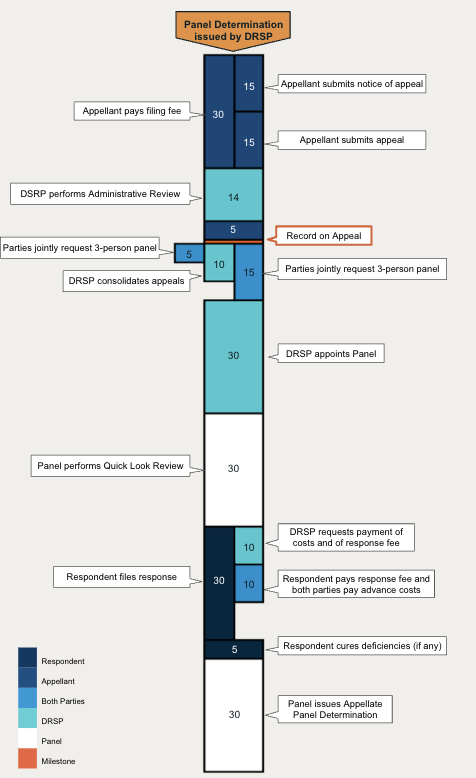
A non-prevailing party to an Objection shall have 15 days from the date the Panel Determination is issued by the DRSP in the Objection proceeding to provide notice to the DRSP of its intent to Appeal the Panel Determination (the Notice of Appeal). The Notice of Appeal must specify those elements of the Panel Determination that are being appealed and must contain a brief statement of the basis for the Appeal.
The Appellant will have 15 days from the date of filing the Notice of Appeal to file the Appeal and pay the required fees as established in Article 8.
The DRSP shall provide notice to the relevant parties and ICANN of the receipt of the Appeal when the filing requirements have been satisfied as specified in Article 7(a) and (b).
The Notice of Appeal and all subsequent documents concerning the Appeal must be filed with the appropriate DRSP, using a model form made available by that DRSP (if applicable), with copies to the Respondent.
The electronic addresses for filing the Notice of Appeal shall be provided in the DRSP Appellate Rules.
An Appellant that wishes to appeal to Panel Determinations from more than one Objection proceeding must file separate appeals with the appropriate DRSP(s).
Article 8. Content of the Appeal
The Appeal shall contain, at a minimum, the following information:
The names and contact information (address, telephone number, email address, etc.) of the Appellant;
Identification of the underlying Objection being appealed; and
A description of the basis for the Appeal, including:
A statement of the grounds upon which the Appeal is being filed, as stated in Article 1 of this Appeal Procedure;
An explanation of the validity of the Appeal and why the Appeal should be upheld.
The substantive portion of the Appeal shall be limited to 5,000 words, excluding attachments. Attachments are not a method to provide additional arguments or evade or circumvent the prescribed word limit.
At the same time as the Appeal is filed, the Appellant shall pay a filing fee in the amount set in accordance with the applicable DRSP Appellate Rules and include evidence of such payment along with the Notice of Appeal. In the event that the filing fee is not paid within 15 days of the Notice of Appeal, the Appeal shall be dismissed without prejudice.
Article 9. Administrative Review of the Appeal
The DRSP shall conduct an administrative review of the Appeal for the purpose of verifying compliance with Articles 5-8 of this Appeal Procedure and the applicable DRSP Appellate Rules, and inform the Appellant, the Respondent and ICANN of the result of its review within 14 days of its receipt of the Appeal. The DRSP may extend this time limit for reasons explained in the notification of such extension.
If the DRSP finds that the Appeal complies with Articles 5-8 of this Appeal Procedure and the applicable DRSP Appellate Rules, the DRSP shall confirm that the Appeal shall be registered for processing.
If the DRSP finds that the Appeal does not comply with Articles 5-8 of this Appeal Procedure and the applicable DRSP Appellate Rules, the DRSP shall have the discretion to request that any administrative deficiencies in the Appeal be corrected within five days of the Appellant receiving the request from the DRSP. If the deficiencies in the Appeal are cured within the specified period but after the lapse of the time limit for submitting an Appeal stipulated by Article 7(a) of this Appeal Procedure, the Appeal shall be deemed to be within this time limit.
If the DRSP finds that the Appeal does not comply with Articles 5-8 of this Appeal Procedure and the applicable DRSP Appellate Rules, and the deficiencies in the Appeal are not corrected within the period specified in Article 9(c), the DRSP shall dismiss the Appeal and close the proceedings, without prejudice to the Appellant's submission of a new Appeal that complies with this Appeal Procedure, provided that the Appeal is filed within the deadline for filing such Appeal. The DRSP’s review of the Appeal shall not interrupt the running of the time limit for submitting an Appeal stipulated by Article 7(a) of this Appeal Procedure.
Immediately upon registering an Appeal for processing, pursuant to Article 9(b), the DRSP shall post the following information about the Appeal on its website: (i) the proposed application and string to which the Appeal is directed; (ii) the name of the Appellant; (iii) a weblink to the Panel Determination from the underlying Objection proceeding; (iv) the grounds for the Appeal; and (v) the dates of the DRSP’s receipt of the Appeal.
Article 10. Record on Appeal
The Record on Appeal will consist of:
the original papers and exhibits filed in the Objection proceeding; and
the transcript of Objection proceedings, if any.
The Parties will cooperate with the DRSP in compiling the Record on Appeal, and the DRSP will provide the record to the Appellate Panel.
Article 11. Consolidation of Appeals
When two or more parties are entitled to Appeal an Objection Panel Determination, and their interests make joinder practicable, they may file a joint Notice of Appeal. They may then proceed on Appeal as a single Appellant.
When the Parties have filed separate timely Notices of Appeal, the Parties shall have five days of the Record on Appeal to propose the consolidation of certain Appeals.
The DRSP shall have 10 days of the Record on Appeal to notify the parties of their decision whether to consolidate certain Appeals (Notice of Consolidation).
In deciding whether to consolidate Appeals, the DRSP shall weigh the benefits (in terms of time, cost, consistency of decisions, etc.) that may result from the consolidation against the possible prejudice or inconvenience that the consolidation may cause. The DRSP’s determination on consolidation shall be final and not subject to further Appeal.
Article 12. The Appellate Panel
The DRSP shall select and appoint the Appellate Panel within 45 days of the Record on Appeal or, where applicable, the Notice of Consolidation.
There shall be a one-person Appellate Panel, unless the Parties to the proceeding mutually agree upon a three-person Panel, bearing the costs as described in Objection and Appeal Fees and Costs. The Parties must notify the DRSP via a joint request within 10 days of the deadline for the parties to propose consolidation or the Notice of Consolidation should they wish to have a three-person Appellate Panel.
All Appellate Panelists acting under this Appeal Procedure shall be impartial and independent of the parties. The applicable DRSP Appellate Rules stipulate the manner by which each Panelist shall confirm and maintain their impartiality and independence.
The applicable DRSP Appellate Rules stipulate the procedures for challenging a Panelist and replacing an Appellate Panelist.
Unless required by a court of law or authorized in writing by the Parties, an Appellate Panelist shall not act in any capacity whatsoever, in any pending or future proceedings, whether judicial, arbitral or otherwise, relating to the matter referred to Panel Determination under this Appeal Procedure.
Article 13. Quick Look Review
Each Appellate Panel shall conduct the Quick Look Review of the Appeal for the purpose of identifying and eliminating Appeals that are manifestly unfounded, an abuse of the right to appeal, or both.
The criteria the Appellate Panel will use to determine whether the Appeal is manifestly unfounded, an abuse of the right to appeal, or both are the following:
The Appeal is not filed by the non-prevailing party to the Objection.
Insufficient or no evidence is provided to support the Appeal.
The Appeal is far-fetched, clearly invented, manifestly contrary to common sense, or so ambiguous that it is objectively impossible for the DRSP to make sense of it.
The Appeal spreads, incites, promotes, or justifies hatred based on intolerance towards a certain group.
The Appeal constitutes harassment of the other party or the Objections itself.
The Appeal includes facts that clearly show that it is manifestly unfounded and/or an abuse of the right to appeal.
The Quick Look Review must be completed within 30 days of the Appellate Panel appointment or conflict mitigation, should conflicts of interest issues be raised by the Parties.
The dismissal of an Appeal that is manifestly unfounded, an abuse of the right to appeal, or both would be an Appellate Panel Determination, rendered in accordance with Article 19 of the Objection Appeal Procedure.
The DRSPs will publish the results of the Quick Look Review on their respective websites and notify the respective Appellants and Respondents of said results.
Article 14. Costs
Each DRSP shall determine the costs for the proceedings that it administers under this Appeal Procedure in accordance with the applicable DRSP Appellate Rules. Such costs shall cover the fees and expenses of the members of the Appellate Panel, as well as the administrative fees of the DRSP (the Costs).
Within 10 days of the publication of the outcome of the Quick Look Review, the DRSP shall estimate the total Costs and request each Party to pay, in advance, the full amount of the estimated Costs to the DRSP. If the Parties agree on a three-person Panel, the Costs will increase as described in Objection and Appeal Fees and Costs.
Both Parties shall make its advance payment of Costs within 10 days of receiving the DRSP’s request for payment and submit to the DRSP evidence of such payment.
Failure to make an advance payment of Costs shall lead to the Panel issuing an Appellate Panel Determination as follows:
If the Appellant fails to make the advance payment of Costs, its Appeal shall be dismissed and no fees that it has paid shall be refunded.
If the Respondent fails to make the advance payment of Costs, the Appeal will be deemed to have been sustained and no fees that the Respondent has paid shall be refunded.
If both Parties fail to make the advance payment of costs, the Appeal shall be dismissed and no fees that the Appellant and Respondent have paid shall be refunded.
The DRSP may revise its estimate of the total Costs and request additional advance payments from the Parties during the proceedings.
Article 15. Response to the Appeal
The Respondent may, but is not required, to file a response to an Appeal (the Response). The Response, if filed, shall be filed within 30 days of the outcome of the results of the Quick Look Review.
The Response must be filed with the appropriate DRSP, using a model form made available by that DRSP, with copies to the Appellant.
If a Response is not filed, the Appellate Panel will presume that Respondent takes no position on the Appeal.
The Response, if filed, shall contain, at a minimum, the following information:
The names and contact information (address, telephone number, email address, etc.) of the Respondent; and
A point-by-point response to the statements made in the Appeal.
The substantive portion of any Response shall be limited to 5,000 words, excluding attachments. Attachments are not a method to provide additional arguments or evade or circumvent the prescribed word limit.
At the same time as the Response is filed, the Respondent shall pay a filing fee in the amount set and published by the relevant DRSP (which shall be the same as the filing fee paid by the Appellant) and include evidence of such payment along with the Response. In the event that the filing fee is not paid within 10 days of the notification of the outcome of the Quick Look Review, any Response shall be disregarded and the Appellate Panel will presume that Respondent takes no position on the Appeal.
If the DRSP finds that the Response does not comply with this Article 15 and the applicable DRSP Appellate Rules, the DRSP shall have the discretion to request that any administrative deficiencies in the Response be corrected within five days of the Respondent receiving the request from the DRSP. If the administrative deficiencies in the Response are cured within the specified period but after the lapse of the time limit for submitting a Response pursuant to this Appeal Procedure, the Response shall be deemed to be within this time limit.
If the deficiencies in the Response are not corrected within the period specified in Article 15(g), the Appellate Panel will presume that the Respondent takes no position on the Appeal.
Article 16. Representation and Assistance
The Parties may be represented or assisted by persons of their choice.
Each Party or Party representative shall communicate the name, contact information and function of such persons to the DRSP and the other Party (or Parties in case of consolidation).
Article 17. Oral Argument
Appeals under this Appeal Procedure and the applicable DRSP Appellate Rules will be determined upon the written documents submitted by the Parties and will be resolved without oral arguments.
Article 18. Standards
The Appellate Panel shall apply the “clearly erroneous” standard of review for each category of Appeal as established in the New gTLD Program. Under a clearly erroneous standard of review, the Appellate Panel must accept the Objection Panel’s findings of fact unless the Objection Panel failed to: (1) follow the appropriate procedures, (2) consider or solicit necessary material evidence or information in the Objection proceeding, or (3) both (1) and (2) and, as a result, the Appellant should have prevailed in the relevant Objection proceeding.
The Appellant bears the burden of proving that its Appeal should be sustained in accordance with the applicable standard.
Article 19. Appellate Panel Determination
The DRSP and the Appellate Panel shall make reasonable efforts to ensure that the Appellate Panel Determination is rendered within 35 days of the deadline for filing a Response. In specific circumstances such as consolidated cases and in consultation with the DRSP, a brief extension may be allowed.
The Appellate Panel shall submit its Appellate Panel Determination in draft form to the DRSP so that the DRSP may review and confirm that the Appellate Panel Determination is in the proper form, unless such DRSP review is specifically excluded by the applicable Appellate Rules. Any changes proposed by the DRSP to the Panel shall address only the form, and not the substance or outcome of the Appellate Panel Determination. The final Appellate Panel Determination shall be communicated to the DRSP, which in turn will communicate that Appellate Panel Determination to the Parties and ICANN.
When the Appellate Panel comprises three Panelists, the Appellate Panel Determination shall be made by a majority of the Appellate Panelists.
The Appellate Panel Determination shall be in writing, shall identify the prevailing Party and shall state the reasons upon which it is based. The Appellate Panel shall take one of the following actions: (1) reject the Appeal and uphold the Objection Panel Determination, or (2) substitute its own determination for the underlying Objection Panel Determination. The Appellate Panel may not order a new Objection proceeding or send the matter back to the original Objection Panel for corrections or further review.
The Appellate Panel Determination shall state the date when it is made, and it shall be signed by the Panelist(s). If any Panelist fails to sign the Appellate Panel Determination, it shall be accompanied by a statement of the reason for the absence of such signature.
In addition to providing electronic copies of its Appellate Panel Determination, the Appellate Panel shall provide a signed hard copy of the Appellate Panel Determination to the DRSP, unless the DRSP Appellate Rules provide otherwise.
Unless the Appellate Panel decides otherwise, the Appellate Panel Determination shall be published in full on the DRSP’s website.
Article 20. Finality of Appeal
Upon the conclusion of the Appeal process, the Appellate Panel Determination shall become the final determination and not subject to further Appeal.
Article 21. Exclusion of Liability
In addition to any exclusion of liability stipulated by the applicable DRSP Rules, the following shall not be liable to any person for any act or omission in connection with any proceeding conducted under this Appeal Procedure, except in cases of willful misconduct or gross negligence: the Appellate Panelist(s) or their employees, the DRSP or its employees, ICANN or its Affiliates, Board members, staff members, employees, agents and consultants.
Article 22. Modification of the Appeal Procedure
ICANN may from time to time, in accordance with its Bylaws and by following the processes described in the Predictability Framework, modify this Procedure.
The version of this Appeal Procedure that is applicable to an Appeal is the version that was in effect on the day when the relevant application for a new gTLD is submitted.
Objections and Appeals Timelines
Note: These are simplified overviews indicating the maximum number of days each process should take, absent extraordinary circumstances. The actual timelines are subject to change based on a number of factors, including, but not limited to, particularly complex cases and the request of cooling-off periods and virtual hearings.
Figure A3-1: Objections Timeline (in days)
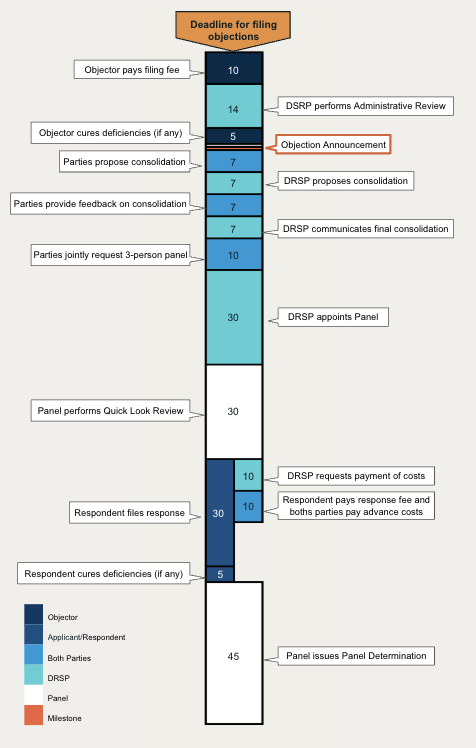
Figure A3-2: Appeals Timeline (in days)