

Appendix 1 Application Questions
A1.1 Overview
The applying entity1 should prepare in advance to provide complete and correct answers to the questions described in this section.
Certain questions will be subjected to evaluation as described in the question matrix and elsewhere in this Guidebook. ICANN may share some or all of an application with third-party expert evaluators under contract with ICANN to evaluate the response against the stated criteria.
The applying entity is expected to follow the instructions carefully and provide complete, commercially reasonable, and good-faith responses to all required questions.
A1.2 Application Questions in the TLD Application Management System
ICANN’s TLD Application Management System (TAMS) will direct the applying entity to provide answers to the appropriate questions given the application type and other factors determined by the policies and procedures described in this Guidebook. The TAMS system uses a progressive or “wizard” approach to collect responses to application questions. TAMS will guide the applying entity to answer the questions necessary for its specific application; not every question will be required for every application.
As noted in Sections 1.2.1.3 and 3.1.3, the application will consist of the following sections to be completed (in this order) upon user registration:
Organization Information
Financial Information
gTLD Application Information
To complete the application, the applying entity must answer a series of questions and provide supporting documents, as required. The system will validate that all mandatory fields include a response before the applying entity can submit its application.
The graphic below provides an overview of the flow of questions in TAMS as it relates to the flow of questions and the question sets described in this Appendix (see Table A1-1).
Figure A1-1 Application Question Sets Flow in TAMS
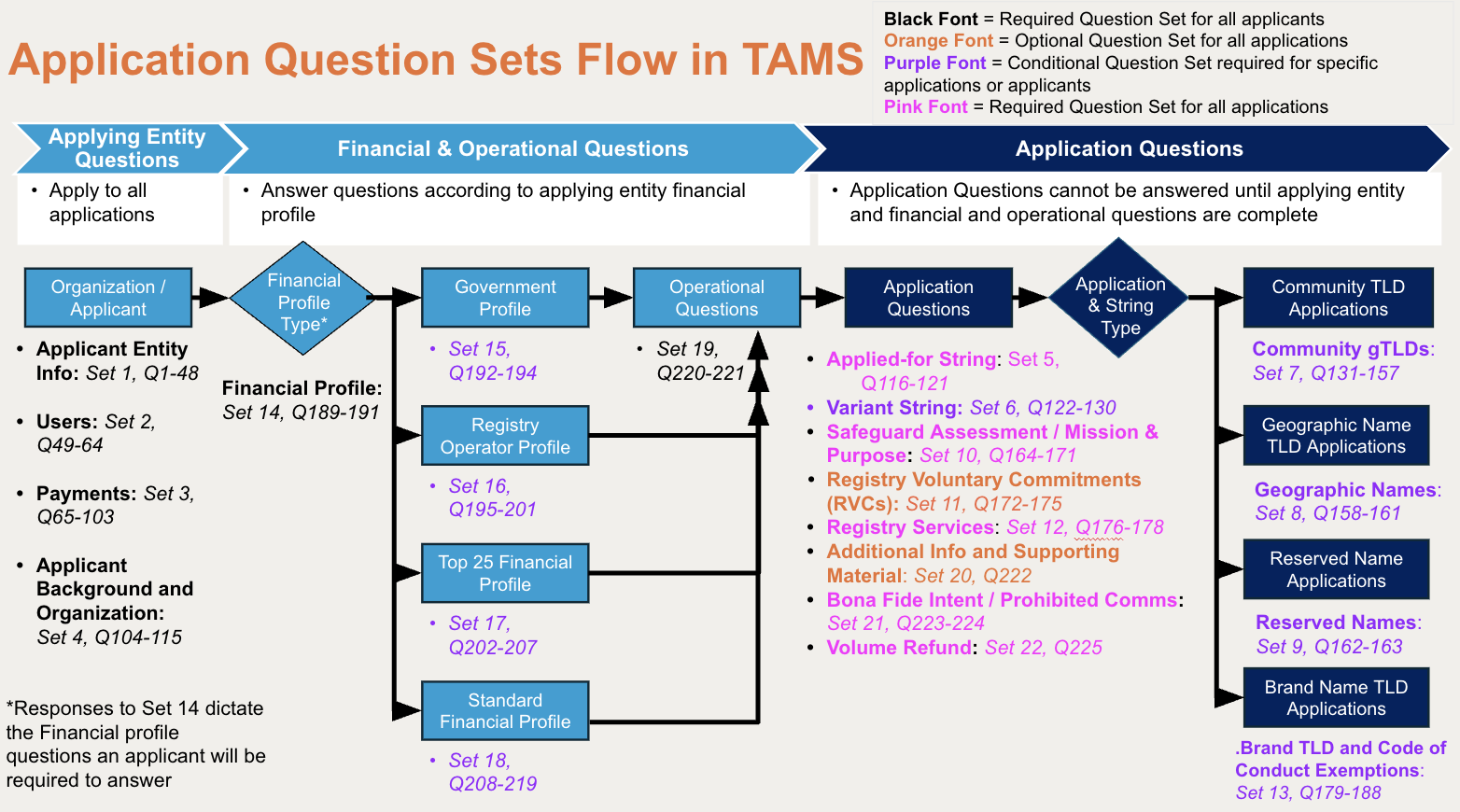
The question sets in Table A1-1 also include the relevant TAMS question number or question set number to help map the application questions listed here to TAMS. As can be seen above, the specific order and question numbers differ slightly from how they appear in this section. Additionally, due to system requirements, some of the wording in the application questions listed here may differ slightly from the TAMS questions to conform to the system and the “wizard”-based approach.
A1.3 Guidelines for Filling out the Application
There are a few key guidelines to keep in mind when filling out the application. The applying entity should:
Answer all organization and financial questions from the perspective of the applying entity.
Include only Latin characters, accented letters, numbers, punctuation, and typographical symbols for all text fields.2
Avoid adding titles, suffixes, or abbreviations in the full legal name fields unless they appear in the official documents for the individual or entity.
See the list of ISO country codes at https://www.iso.org/obp/ui for all fields requesting a two-letter ISO country code.
Table A1-1 Application Question Sets and Descriptions
| Set | Focus of Questions | TAMS Section Number and Name | Purpose | Applicable to |
|---|---|---|---|---|
| 1 | Applying Entity3 Information | TAMS.0. Applicant Organization Information | This question set collects information regarding the legal entity that would enter into a Registry Agreement with ICANN upon successful completion of all relevant application processes. The information collected is intended to be used for background screening. | All applying entity and application types |
| 2 | Users | TAMS.0. Applicant Organization Information | This question set collects information related to the individuals who will have access to TAMS, manage the application, and receive inquiries. | All applying entity and application types |
| 3 | Payments | TAMS.0. Applicant Organization Information | This question set collects the requisite Information for invoicing, payments, and refunds. | All applying entity and application types |
| 4 | Applicant Background and Organization | TAMS.0. Applicant Organization Information | This question set collects the requisite Information for conducting the background screening checks. | All applying entity and application types |
| 5 | Applied-for String | TAMS.1. Primary String | This question set collects basic information regarding the string that is being applied for (for example, a-label, meaning, script). | All applying entity and application types |
| 6 | Variant String(s) | TAMS.2. Variant String | This question set collects basic information regarding any variants of the primary string that are being applied for. | All applying entity and application types that are also applying for a variant string |
| 7 | Community gTLDs | TAMS.3. Community | This question set collects information specific to Community gTLDs. See 7.1.2.1 Applications for Community gTLDs. | Applying entities for Community gTLDs |
| 8 | Geographic Names | TAMS.4. Geographic Determination | This question set collects information specific to Geographic Names. See 7.5 Geographic Names. | Applying entities for Geographic Names |
| 9 | Reserved Names | TAMS.5. Reserved Names | This question set collects information specific to Reserved Names. See 7.2.2 Reserved Names. | Applying entities for Reserved Names |
| 10 | Safeguard Assessment/Mission and Purpose | TAMS.6. Safeguard Identification | This question set collects information related to determining whether certain Safeguard Public Interest Commitments (Safeguard PICs) are required for the applied-for gTLD string (see 7.8.2.3 Safeguard PICs). | All applying entity and application types |
| 11 | Registry Voluntary Commitments (RVCs) | TAMS.7. Registry Voluntary Commitments (RVCs) | This question set collects information related to any Registry Voluntary Commitments (RVCs) that the applying entity is submitting. See also Section 7.8.3 Registry Voluntary Commitments. | Applying entities wishing to submit RVCs |
| 12 | Registry Services | TAMS.8. Registry Service Provider | This question set collects information regarding any selected RSPs and the registry services that the applying entity intends to provide as a registry operator for the applied-for gTLD string. | All applying entity and application types |
| 13 | .Brand TLD and Code of Conduct Exemptions | TAMS.9. .Brand & Code of Conduct Exemptions | This question set collects information related to whether the applied-for gTLD string is a .Brand or if the applying entity is seeking a Code of Conduct exemption. See also Section 7.3 .Brand TLD Eligibility Evaluation and Section 7.4 Code of Conduct Exemption Evaluation. | Applying entities for .Brand TLDs or wishing to limit registrations |
| 14 | Financial Profile Determination | TAMS.0. Applicant Organization Information | Based on defined criteria and the responses of the applying entity to the questions below, ICANN will assign each applying entity one of the four financial profiles. See also Section 6.2 Financial and Operational Evaluation. | All applying entity and application types |
| 15 | Government Financial Profile | TAMS.0. Applicant Organization Information | This question set collects information related to applying entities that have been assigned the government profile. | Applying entities in the “Government Profile” |
| 16 | Registry Operator Financial Profile | TAMS.0. Applicant Organization Information | This question set collects information related to applying entities that have been assigned the Registry Operator profile. | Applying entities in the “Registry Operator Profile” |
| 17 | Top 25 Financial Profile | TAMS.0. Applicant Organization Information | This question set collects information related to applying entities that have been assigned the Top 25 Profile. | Applying entities in the “Top 25 Profile” |
| 18 | Standard Financial Profile | TAMS.0. Applicant Organization Information | This question set collects information related to applying entities that have been assigned the Standard Profile. | Applying entities in the “Standard Profile” |
| 19 | Operational Questions | TAMS.0. Applicant Organization Information | This question set collects additional information related to the operations of an applying entity. | All applying entity and application types |
| 20 | Additional Information and Supporting Material | TAMS.10. Additional Information and Supporting Material | This question set collects any additional information that the applying entity would like to provide, including any supporting materials. | All applying entity and application types |
| 21 | Bona Fide Intent and Prohibited Communications | TAMS.11. Bona Fide Intent and Prohibited Communications | This question set contains attestations related to the applying entity’s acknowledgment of bona fide intent and prohibited communications (see Section 5.2.3.1 Prohibited Communications and Activities). | All applying entity and application types |
| 22 | Volume Refund | TAMS.12. Volume Refund | This question set contains the applying entity’s preference for the Volume Refund. See also Section 3.3.3.2 Application Volume Refund. | All applying entity and application types |
Question Set 1: Applying Entity Information
This question set collects information regarding the legal entity that would enter into a Registry Agreement with ICANN upon successful completion of all relevant application processes. This information collected under this question set is intended to be used for background screening. Any material misstatement or misrepresentation (or omission of material information) may cause the application to be rejected.
Sub- section |
# | Question | Public Posting | Notes/Instructions | Criteria | Input Field Requirements |
|---|---|---|---|---|---|---|
| Applying Entity | 1 | Full Legal Name4 | Yes | Instructions: Provide the full legal name of the applying entity as it appears on the official registration documents. Do not use abbreviations. |
CR-1. Enter appropriate information in text field. | 255 character limit |
| Applying Entity | 2 | Doing Business As | Yes | Instructions: Provide the name under which the applying entity is doing business, if different from the full legal name answered in Question 1. Such a name must be registered with appropriate local jurisdiction or public authority. |
CR-1. Enter appropriate information in text field. | 255 character limit |
| Applying Entity | 3 | Legal Entity Form/Business Structure | Yes | Instructions: Provide the long form (no acronyms) of the legal entity form/business structure of the applying entity as it appears on the official registration documents. If the original script of the legal entity form/business structure is not English, ONLY provide its official English translation. No additional information should be provided as this will be used for the automatic population of the Registry Agreement. Notes: 1. Legal entity form/business structure refers to the type of business the entity is registered as. 2. Examples of legal forms/business structures may include "Corporation", "Limited Liability Company", "Public/Private Limited Company (Ltd.)", “Nonprofit”, “Government Entity”, “Intergovernmental Organization”, etc. 3. Natural persons and sole proprietorships do not qualify. 4. This is not the same as the full legal name of the entity. |
CR-1. Enter appropriate information in text field. | 255 character limit |
| Applying Entity | 4 | Jurisdiction | Yes | Instructions: The jurisdiction indicates the location in which the business of the applying entity is registered for legal and financial purposes. This is either 1) a country name, or a 2) state/territory name, depending on where the applying entity is registered. No additional information should be provided as this will be used for the automatic population of the Base Registry Agreement. Examples include "Delaware", "Germany", etc. |
CR-1. Enter appropriate information in text field. | 255 character limit |
| Applying Entity | 5 | Tax ID, Business ID, VAT Registration Number, or Equivalent | No | Instructions: Enter the number issued such as a Tax ID, Business ID, VAT Registration Number, or equivalent issued by the local jurisdiction. |
CR-1. Enter appropriate information in text field. | 255 character limit |
| Applying Entity | 6 | Issuing Authority | No | Instructions: Enter the name of the authority that issued the Tax ID, Business ID, VAT Registration Number, or equivalent as per answer to question 5. |
CR-1. Enter appropriate information in text field. | 255 character limit |
| Applying Entity | 7 | Legal Entity Identifier (LEI) | No | Instructions: Enter the Legal Entity Identifier (LEI), a 20-character, alpha-numeric code that uniquely identifies legal entities participating in financial transactions, for the applying entity, if available. |
CR-1. Enter appropriate information in text field. | Must be 20 alphanumeric (a-z, 0-9) characters |
| Applying Entity | 8 | Proof of Establishment | No | Instructions: 1. Provide articles of incorporation/association/organization or other equivalent documents filed with the issuing authority (statutes, membership agreement, etc.) of the entity. 2. If the applying entity is a government body/organization or an intergovernmental organization, provide a certified copy of the relevant statute or governmental decision under which it has been established. |
CR-1. Upload the appropriate documentation. | Upload no more than 10 pages, subject to acceptable file types. |
| Applying Entity | 9 | Proof of Good Standing | No | Instructions: 1. Provide a good standing certificate (or equivalent) that states that the applying entity is, among other things, compliant with annual filing requirements, active, not subject to any administrative orders or action against it, not in liquidation, is current on any required fees and dues, etc. 2. Where the authority that issues business registration documents in the applying entity's jurisdiction does not maintain documentation of good standing (or equivalent), such that the applying entity cannot provide this documentation, the applying entity must submit an affidavit drafted and signed by a notary public or a legal practitioner duly qualified in the courts of the applying entity’s jurisdiction, declaring that the organization is established and in good standing. |
CR-1. Upload the appropriate documentation. CR-2. Good standing certificate must be no more than six months old at the time of application submission. |
Upload no more than 10 pages, subject to acceptable file types. |
| Applying Entity | 10 | Website URL | Yes | Instructions: Provide the website URL of the applying entity, if available. Notes: A valid URL must start with 'http://' or 'https://' followed by the domain name (for example, “https://www.example.com”). |
CR-1. Enter a valid URL in the text field. | 1. 255 character limit 2. Entered text must be valid URL |
| Applying Entity | 11 | Is the applying entity an existing registry operator, ICANN accredited registrar, or an Affiliate of either? | Yes | Instructions: 1. Choose Yes or No. 2. Use the definition of Affiliate from the Base Registry Agreement (see Base Registry Agreement: https://www.icann.org/en/registry-agreements/base-agreement). |
CR-1. Select from Radio Buttons - Yes/No | An option must be selected |
| Applying Entity | 12 | If "Yes", explain. | Yes | Instructions: 1. Specify if the applying entity is an existing registry operator, ICANN accredited registrar, and/or an Affiliate of a registry operator and/or registrar. 2. If the applying entity is an Affiliate, provide the details of such Affiliate relationship, including the name of the affiliated registry operator and/or registrar. 3. If the applying entity is an ICANN accredited registrar, specify the registrar ID number. |
CR-1. Enter appropriate information in text field. | 4000 character limit |
| Applying Entity | 13 | Is the applying entity a back-end registry service provider (RSP), an ICANN-approved data escrow agent, an emergency back-end registry operator, a Uniform Rapid Suspension (URS) service provider, an ICANN dispute resolution service provider, a Privacy or Proxy Service Provider, or a Reseller? | Yes | Instructions: 1. Choose Yes or No. |
CR-1. Select from Radio Buttons - Yes/No | An option must be selected |
| Applying Entity | 14 | If the applying entity is an Affiliate of any of the entities listed in Question 13, explain. | Yes | Instructions: 1. Use the definition of Affiliate from the Base Registry Agreement (see Base Registry Agreement: https://www.icann.org/en/registry-agreements/base-agreement). 2. Provide the type of the provider and the name of the applicable entity of which the applying entity is an Affiliate. |
CR-1. Enter appropriate information in the text field. | 4000 character limit |
| Stock and Exchange | 15 | Stock Symbol | Yes | Instructions: 1. If the applying entity is publicly traded, provide its stock symbol. 2. If the applying entity is traded under multiple symbols/tickers, provide the symbol of the entity's primary equity listing that has the most units outstanding. |
CR-1. Enter appropriate information in text field. | 255 character limit |
| Stock and Exchange | 16 | Stock Exchange | Yes | Instructions: 1. If the applying entity is publicly traded, select the Stock Exchange with which the applying entity is listed. 2. If the applying entity is traded on multiple exchanges, provide the exchange of the entity's primary equity listing. |
CR-1. Select an option from the dropdown menu. | Choose one of the provided options. |
| Primary Business Phone | 17 | Phone Country Code | Yes | CR-1. Select from a Dropdown Menu of Country Codes (taken from ISO list). | An option must be selected. | |
| Primary Business Phone | 18 | Primary Business Phone | Yes | Instructions: Provide the primary business phone number without including the country code. |
CR-1. Enter appropriate information in text field. | Must be valid phone number format |
| Primary Business Email Address | 19 | Primary Business Email Address | Yes | Instructions: Provide the primary business email address of the applying entity. |
CR-1. Enter a valid email address in the text field. | 1. 255 character limit 2. Entered text must be valid email address. |
| Primary Business Address | 20 | Address Line 1 | Yes | Instructions: Enter the street address (no PO Box). |
CR-1. Enter appropriate information in text field. | 1. 255 character limit 2. Must be a physical address, no PO Box. |
| Primary Business Address | 21 | Address Line 2 | Yes | CR-1. Enter appropriate information in text field. | 255 character limit | |
| Primary Business Address | 22 | Locality | Yes | Instructions: Enter the city, village, municipality, etc. |
CR-1. Enter appropriate information in text field. | 255 character limit |
| Primary Business Address | 23 | State/Province/Region | Yes | Instructions: Enter the state, province, department, territory, prefecture, oblast, etc., if applicable. |
CR-1. Enter appropriate information in text field. | 255 character limit |
| Primary Business Address | 24 | Postal Code | Yes | Instructions: 1. Enter the postal code, if applicable. 2. If a postal code does not exist, type “Not Applicable”. |
CR-1. Enter appropriate information in text field. | 255 character limit |
| Primary Business Address | 25 | Country Code of Location | Yes | CR-1. Select from a Dropdown Menu of Country Codes (taken from ISO list). | An option must be selected. | |
| Direct Parent Company | 26 | Full Legal Name | Yes | Instructions: If applicable, provide the full legal name as it appears on the official registration documents of the Direct Parent Company of the applying entity. Do not use abbreviations. Notes: “Direct Parent Company” means, with respect to an Applicant, the entity that directly possesses the power to direct the management and policies of such Applicant through the ownership of voting securities, as a general partner, as a managing member, by contract, or otherwise. |
CR-1. Enter appropriate information in text field.Notes: CR-2. If this field is populated, all following questions in this subsection Questions 27-35) are required. |
255 character limit |
| Direct Parent Company | 27 | Doing Business As | Yes | Instructions: Provide the name under which the Direct Parent Company is doing business, if different from the full legal name answered in Question 26. Such a name must be registered with appropriate local jurisdiction or public authority. |
CR-1. Enter appropriate information in text field. | 255 character limit |
| Direct Parent Company | 28 | Legal Entity Form/Business Structure | Yes | Instructions: Provide the long form (no acronyms) of the legal entity form/business structure of the Direct Parent Company as it appears on the official registration documents. If the original script of the legal entity form/business structure is not English, ONLY provide its official English translation. Notes: 1. Legal entity form/business structure refers to the type of business the entity is registered as. 2. Examples of legal forms may include "Corporation", "Limited Liability Company", "Public/Private Limited Company (Ltd.)", “Nonprofit”, “Government Entity”, “Intergovernmental Organization”, etc. 3. Natural persons and sole proprietorships do not qualify. 4. This is not the same as the full legal name of the entity. |
CR-1. Enter appropriate information in text field. | 255 character limit |
| Direct Parent Company | 29 | Jurisdiction | Yes | Instructions: The jurisdiction indicates the location in which the business of the Direct Parent Company is registered for legal and financial purposes. This is either 1) a country name, or a 2) state/territory name, depending on where the Direct Parent Company is registered. Examples include "Delaware", "Germany", etc. |
CR-1. Enter appropriate information in text field. | 255 character limit |
| Direct Parent Company | 30 | Address Line 1 | No | Instructions: Enter the street address (no PO Box). |
CR-1. Enter appropriate information in text field. | 1. 255 character limit 2. Must be a physical address, no PO Box. |
| Direct Parent Company | 31 | Address Line 2 | No | CR-1. Enter appropriate information in text field. | 255 character limit | |
| Direct Parent Company | 32 | Locality | No | Instructions: Enter the city, village, municipality, etc. |
CR-1. Enter appropriate information in text field. | 255 character limit |
| Direct Parent Company | 33 | State/Province/Region | No | Instructions: Enter the state, province, department, territory, prefecture, oblast, etc., if applicable. |
CR-1. Enter appropriate information in text field. | 255 character limit |
| Direct Parent Company | 34 | Postal Code | No | Instructions: 1. Enter the postal code, if applicable. 2. If a postal code does not exist, type “Not Applicable”. |
CR-1. Enter appropriate information in text field. | 255 character limit |
| Direct Parent Company | 35 | Country Code of Location | No | CR-1. Select from a Dropdown Menu of Country Codes (taken from ISO list). | An option must be selected | |
| Ultimate Parent Company | 36 | Full Legal Name | Yes | Instructions: If applicable, provide the full legal name as it appears on the official registration documents of the Ultimate Parent Company of the applying entity. Do not use abbreviations. Notes: “Ultimate Parent Company” means, with respect to an Applicant (and, if applicable, a Direct Parent Company), the top-level entity that directly or indirectly possesses the power to direct the management and policies of such Applicant (and, if applicable, a Direct Parent Company) through the ownership of voting securities, as a general partner, as a managing member, by contract, or otherwise. An Ultimate Parent Company is not controlled by any other entity. If there are no intermediary entities between the Applicant and the Ultimate Parent Company, the Ultimate Parent Company would be the same entity as the Direct Parent Company. |
CR-1. Enter appropriate information in text field. CR-2. If this field is populated, all following questions in this subsection (Questions 37-48) are required. |
255 character limit |
| Ultimate Parent Company | 37 | Doing Business As | Yes | Instructions: Provide the name under which the Ultimate Parent Company is doing business, if different from the full legal name answered in Question 36. Such a name must be registered with appropriate local jurisdiction or public authority. |
CR-1. Enter appropriate information in text field. | 255 character limit |
| Ultimate Parent Company | 38 | Legal Entity Form/Business Structure | Yes | Instructions: Provide the long form (no acronyms) of the legal entity form/business structure of the Ultimate Parent Company as it appears on the official registration documents. If the original script of the legal entity form/business structure is not English, ONLY provide its official English translation. Notes: 1. Legal entity form/business structure refers to the type of business the entity is registered as. 2. Examples of legal forms may include "Corporation", "Limited Liability Company", "Public/Private Limited Company (Ltd.)", “Nonprofit”, “Government Entity”, “Intergovernmental Organization”, etc. 3. Natural persons and sole proprietorships do not qualify. 4. This is not the same as the full legal name of the entity. |
CR-1. Enter appropriate information in text field. | 255 character limit |
| Ultimate Parent Company | 39 | Jurisdiction | Yes | Instructions: The jurisdiction indicates the location in which the business of the Ultimate Parent Company is registered for legal and financial purposes. This is either 1) a country name, or a 2) state/territory name, depending on where the Direct Parent Company is registered. Examples include "Delaware", "Germany", etc. |
CR-1. Enter appropriate information in text field. | 255 character limit |
| Ultimate Parent Company | 40 | Address Line 1 | No | Instructions: Enter the street address (no PO Box) |
CR-1. Enter appropriate information in text field. | 1. 255 character limit 2. Must be a physical address, no PO Box. |
| Ultimate Parent Company | 41 | Address Line 2 | No | CR-1. Enter appropriate information in text field. | 255 character limit | |
| Ultimate Parent Company | 42 | Locality | No | Instructions: Enter the city, village, municipality, etc. |
CR-1. Enter appropriate information in text field. | 255 character limit |
| Ultimate Parent Company | 43 | State/Province/Region | No | Instructions: Enter the state, province, department, territory, prefecture, oblast, etc., if applicable. |
CR-1. Enter appropriate information in text field. | 255 character limit |
| Ultimate Parent Company | 44 | Postal Code | No | Instructions: 1. Enter the postal code, if applicable. 2. If a postal code does not exist, type “Not Applicable”. |
CR-1. Enter appropriate information in text field. | 255 character limit |
| Ultimate Parent Company | 45 | Country Code of Location | No | CR-1. Select from a Dropdown Menu of Country Codes (taken from ISO list). | An option must be selected. | |
| Ultimate Parent Company | 46 | Graphical Representation of Ownership | No | Instructions: Provide a graphical representation of ownership (for example, an organizational chart), which includes percentages of the associated entities or persons from the applying entity to the Ultimate Parent Company. |
CR-1. Upload the appropriate documentation. | Upload no more than 10 pages, subject to acceptable file types. |
| Applying Entity | 47 | After reviewing the Base Registry Agreement, does the applying entity believe there are any unique legal, jurisdictional, or regulatory issues that would prevent the applying entity from executing the agreement as-is? As the Registry Agreement is a product of extensive community consultation, ICANN only considers modification to it in extraordinary circumstances. | No | Instructions: Choose Yes or No. |
CR-1. Select from Radio Buttons - Yes/No | An option must be selected. |
| Applying Entity | 48 | If the applying entity answered yes to the above Question #47, please briefly explain. | No | Instructions: Provide an explanation. |
CR-1. Enter appropriate information in text field. CR-2. Text allowed is 4,000 characters or less. |
4000 character limit |
Question Set 2: Users
This question set collects information related to the individuals who will have access to TLD Application Management System (TAMS), manage the application, and receive inquiries. Information for two (2) distinct Primary Users must be provided. Information for up to five (5) distinct Additional Users may be entered. Multiple Users repeat #49-64.
Sub- section |
# | Question | Public Posting | Notes/Instructions | Criteria | Input Field Requirements |
|---|---|---|---|---|---|---|
| Primary User | 49 | Full Legal Name | No | Instructions: Enter the full legal name of the Primary User as it appears on their passport or government-issued ID. Enter the full legal name in the local script or language and provide the name of the script or language in English, if applicable. Notes: 1. Primary User is defined as the individual designated by the applying entity with the primary responsibility for management of the application, including responding to tasks in the TLD Application Management System (TAMS) during the various application phases. The Primary User listed should also be prepared to receive inquiries from ICANN and the public. 2. Information for two (2) Primary Users must be provided. 3. Information for up to five (5) Additional Users may be provided, if desired. Additional Users may access TAMS at a limited capacity to assist the Primary Users with respect to the application. |
CR-1. Enter appropriate information in text field. | 255 character limit |
| Primary User | 50 | Address Line 1 | No | Instructions: Enter the mailing address of the Primary User. |
CR-1. Enter appropriate information in text field. | 255 character limit |
| Primary User | 51 | Address Line 2 | No | CR-1. Enter appropriate information in text field. | 255 character limit | |
| Primary User | 52 | Locality | No | Instructions: Enter the city, village, municipality, etc. |
CR-1. Enter appropriate information in text field. | 255 character limit |
| Primary User | 53 | State/Province/Region | No | Instructions: Enter the state, province, department, territory, prefecture, oblast, etc., if applicable. |
CR-1. Enter appropriate information in text field. | 255 character limit |
| Primary User | 54 | Postal Code | No | Instructions: 1. Enter the postal code, if applicable. 2. If a postal code does not exist, type “Not Applicable”. |
CR-1. Enter appropriate information in text field. | 255 character limit |
| Identifying Information | 55 | Country Code of Business Location/Address | No | CR-1. Select from a Dropdown Menu of Country Codes (taken from ISO list). | An option must be selected. | |
| Identifying Information | 56 | Year of Birth | No | CR-1. Enter appropriate information in text field. | An option must be selected. | |
| Identifying Information | 57 | Phone Country Code | No | CR-1. Select from a Dropdown Menu of Country Codes (taken from ISO list). | An option must be selected. | |
| Identifying Information | 58 | Phone Number | No | Instructions: Provide the business phone number of the user without including the country code. |
CR-1. Enter appropriate information in text field. | Must be valid phone number format |
| Identifying Information | 59 | Email Address | No | Instructions: A distinct email address for each user is required in order to protect the access to the system of the applying entity, should one of the users lose its credentials. |
CR-1. Enter a valid email address in the text field. | 1. 255 character limit 2. Entered text must be valid email address. |
| Identifying Information | 60 | Country Code of Residence | No | CR-1. Select from a Dropdown Menu of Country Codes (taken from ISO list). | An option must be selected | |
| Identifying Information | 61 | Percentage of Shares | No | Instructions: Provide the percentage of shares of the applying entity owned by this user, in the numerical value form (for example, 15%, etc.). |
CR-1. Enter appropriate information in text field. | 255 character limit |
| Identifying Information | 62 | Organization Title in the Applying Entity | No | Instructions: Provide the title of this user with respect to the organization of the applying entity (for example, CEO, CFO, Director, etc.). If the user is not employed by the applying entity, indicate "contractor," "consultant," or equivalent. |
CR-1. Enter appropriate information in text field. | 255 character limit |
| Identifying Information | 63 | Does this user hold the position of Director, Officer, or some other position of significant influence? If yes, please list the title. | No | Instructions: 1. If the user holds a position of significant influence, please list the title in the space provided. 2. If not, type "Not Applicable" |
CR-1. Enter appropriate information in text field. | 255 character limit |
| Identifying Information | 64 | Is this user a Signatory Officer of the applying entity? | No | Notes: A signatory officer is an individual authorized to sign legally binding documents on behalf of the applying entity. |
CR-1. Select from Radio Buttons - Yes/No | An option must be selected |
Question Set 3: Payments
This question set collects the requisite Information for invoicing, payments, and refunds. Note, all banking information will be kept confidential; invoices will be issued prior to any payment necessary for the gTLD Application processing.
Sub- section |
# | Question | Public Posting | Notes/Instructions | Criteria | Input Field Requirements |
|---|---|---|---|---|---|---|
| Payor | 65 | Full Legal Name | No | Instructions: 1. Provide information on who will be making payments with respect to the application on behalf of the applying entity. 2. If the payor is a business, provide the full legal name as it appears on the official registration documents of the payor. Do not use abbreviations. 3. If the payor is an individual, provide the full legal name of the payor as it appears on their passport or government-issued ID. Enter the full legal name in the local script or language and provide the name of the script or language in English, if applicable. 4. If the payor is an individual, TAMS will also request the following information: country code of residence, title of the individual, and year of birth. |
CR-1. Enter appropriate information in text field. | 255 character limit |
| Payor | 66 | Doing Business As (If Applicable) | No | Instructions: If the payor is a business, provide the name under which the payor is doing business, if different from the full legal name answered in Question 65. Such a name must be registered with appropriate local jurisdiction or public authority. |
CR-1. Enter appropriate information in text field. CR-2. This field is only required if the payor is a business entity. |
255 character limit |
| Payor | 67 | Legal Entity Form/Business Structure (If Applicable) | No | Instructions: If the payor is a business, provide the long form (no acronyms) of the legal entity form/business structure of the payor as it appears on the official registration documents. If the original script of the legal entity form/business structure is not English, ONLY provide its official English translation. Notes: 1. Legal entity form/business structure refers to the type of business the entity is registered as. 2. Examples of legal forms may include "Corporation", "Limited Liability Company", "Public/Private Limited Company (Ltd.)", “Nonprofit”, “Government Entity”, “Intergovernmental Organization”, etc. 3. Natural persons and sole proprietorships do not qualify. 4. This is not the same as the full legal name of the entity. |
CR-1. Enter appropriate information in text field. CR-2. This field is only required if the payor is a business entity. |
255 character limit |
| Payor | 68 | Jurisdiction (If applicable) | No | Instructions: Answer this question if the payor is a business. The jurisdiction indicates the location in which the business of the payor is registered for legal and financial purposes. This is either 1) a country name, or a 2) state/territory name, depending on where the payor is registered. Examples include "Delaware", "Germany", etc. |
CR-1. Enter appropriate information in text field. CR-2. This field is only required if the payor is a business entity. |
255 character limit |
| Payor Primary Business Address | 69 | Address Line 1 | No | Instructions: Enter the street address (No PO Box) of the primary business address of the payor. |
CR-1. Enter appropriate information in text field. | 1. 255 character limit 2. Must be a physical address, no PO Box. |
| Payor Primary Business Address | 70 | Address Line 2 | No | CR-1. Enter appropriate information in text field. | 255 character limit | |
| Payor Primary Business Address | 71 | Locality | No | Instructions: Enter the city, village, municipality, etc. |
CR-1. Enter appropriate information in text field. | 255 character limit |
| Payor Primary Business Address | 72 | State/Province/Region | No | Instructions: Enter the state, province, department, territory, prefecture, oblast, etc., if applicable. |
CR-1. Enter appropriate information in text field. | 255 character limit |
| Payor Primary Business Address | 73 | Postal Code | No | Instructions: 1. Enter the postal code, if applicable. 2. If a postal code does not exist, type “Not Applicable”. |
CR-1. Enter appropriate information in text field. | 255 character limit |
| Payor Primary Business Address | 74 | Country Code of Location | No | CR-1. Select from a Dropdown Menu of Country Codes (taken from ISO list). | An option must be selected | |
| Financial Institution | 75 | Financial Institution Name | No | Instructions: Provide the name of the financial institution (for example, the name of a bank, credit union, investment firm, etc.). |
CR-1. Enter appropriate information in text field. | 255 character limit |
| Financial Institution | 76 | Beneficiary Name | No | Instructions: Provide the beneficiary name as it appears on the account in the financial institution listed in the answer to Question 75 bank account. A beneficiary is defined as the registered owner of the account being used for payment with respect to the application. |
CR-1. Enter appropriate information in text field. | 255 character limit |
| Financial Institution | 77 | Address Line 1 | No | Instructions: Provide the mailing address of the bank branch that is associated with the account information provided in the answers to Questions 85-90. |
CR-1. Enter appropriate information in text field. | 255 character limit |
| Financial Institution | 78 | Address Line 2 | No | CR-1. Enter appropriate information in text field. | 255 character limit | |
| Financial Institution | 79 | Locality | No | Instructions: Enter the city, village, municipality, etc. of the bank branch that is associated with the account information provided in answers to Questions 85-90. |
CR-1. Enter appropriate information in text field. | 255 character limit |
| Financial Institution | 80 | State/Province/Region | No | Instructions: Enter the state, province, department, territory, prefecture, oblast, etc. (if applicable) of the bank branch which the applying entity will use to wire fees to ICANN and is associated with the account information provided in answers to Questions 85-90. |
CR-1. Enter appropriate information in text field. | 255 character limit |
| Financial Institution | 81 | Postal Code | No | Instructions: 1. Enter the postal code of the bank branch that is associated with the account information provided in answers to Questions 85-90, if applicable. 2. If a postal code does not exist, type “Not Applicable”. |
CR-1. Enter appropriate information in text field. | 255 character limit |
| Financial Institution | 82 | Country Code of Location | No | Instructions: Choose the Country Code of the bank branch that is associated with the account information provided in answers to Questions 85-90. |
CR-1. Select from a Dropdown Menu of Country Codes (taken from ISO list). | An option must be selected |
| Financial Institution | 83 | Legal Entity Form/Business Structure | No | Instructions: Provide the long form (no acronyms) of the legal entity form/business structure of the financial institution as it appears on the official registration documents. If the original script of the legal entity form/business structure is not English, ONLY provide its official English translation. Notes: 1. Legal entity form/business structure refers to the type of business the entity is registered as. 2. Examples of legal forms may include "Corporation", "Limited Liability Company", "Public/Private Limited Company (Ltd.)", “Nonprofit”, “Government Entity”, “Intergovernmental Organization”, etc. 3. Natural persons and sole proprietorships do not qualify. 4. This is not the same as the full legal name of the entity. |
CR-1. Enter appropriate information in text field. | 255 character limit |
| Financial Institution | 84 | Jurisdiction | No | Instructions: The jurisdiction indicates the location in which the business of the financial institution is registered for legal and financial purposes. This is either 1) a country name, or a 2) state/territory name, depending on where the financial institution is registered. Examples include "Delaware", "Germany", etc. |
CR-1. Enter appropriate information in text field. | 255 character limit |
| Financial Institution | 85 | Transit/Domestic Routing Number | No | Instructions: Provide the Transit/Domestic Routing Number of the payor. |
CR-1. Enter appropriate information in text field. | 255 character limit |
| Financial Institution | 86 | IBAN | No | Instructions: Provide the International Bank Account Number (IBAN) of the payor, if applicable. Notes: IBAN consists of up to 34 alphanumeric characters, beginning with a two-letter country code, followed by two check digits used for security purposes. What comes next is a string of domestic banking details, referred to as Basic Bank Account Numbers (BBAN): the bank identifier code, Branch code (also known as Sort Code in UK), and the bank account number. |
CR-1. Enter appropriate information in text field. | 255 character limit |
| Financial Institution | 87 | SWIFT Code | No | Instructions: Provide the SWIFT Code of the payor. The SWIFT Code is also known as Bank Identifier Code (BIC code). The code must be 8 or 11 alphanumeric [0-9,a-z] characters. |
CR-1. Enter appropriate information in text field. | Must be 8 or 11 alphanumeric [0-9,a-z] characters |
| Financial Institution | 88 | Account Number | No | Instructions: Provide the account number of the payor. |
CR-1. Enter appropriate information in text field. | 255 character limit |
| Financial Institution | 89 | Account Type | No | Instructions: Select an account type of the payor. |
CR-1. Enter appropriate information in text field. | An option must be selected |
| Financial Institution | 90 | Account Category | No | Instructions: Select the account category of the payor. |
CR-1. Select from a Dropdown Menu. CR-2. Options are: Non-US, US Business, US Corporate, or US Personal. |
An option must be selected |
| Billing Point of Contact | 91 | Full Legal Name | No | Instructions: Enter the full legal name of the individual serving as a Billing Point of Contact as it appears on their passport or government-issued ID. Enter the full legal name in the local script or language and provide the name of the script or language in English, if applicable. Notes: 1. The Billing Point of Contact is the individual designated with the billing related responsibility, such as making payments and handling refund related matters. 2. If the Billing Point of Contact is the same as one of the users as provided under Question Set 2, please re-enter the information of the user. |
CR-1. Enter appropriate information in text field. | 255 character limit |
| Billing Point of Contact | 92 | Address Line 1 | No | Instructions: Enter the mailing address of the Billing Point of Contact. |
CR-1. Enter appropriate information in text field. | 255 character limit |
| Billing Point of Contact | 93 | Address Line 2 | No | CR-1. Enter appropriate information in text field. | 255 character limit | |
| Billing Point of Contact | 94 | Locality | No | Instructions: Enter the city, village, municipality, etc. |
CR-1. Enter appropriate information in text field. | 255 character limit |
| Billing Point of Contact | 95 | State/Province/Region | No | Instructions: Enter the state, province, department, territory, prefecture, oblast, etc., if applicable. |
CR-1. Enter appropriate information in text field. | 255 character limit |
| Billing Point of Contact | 96 | Postal Code | No | Instructions: 1. Enter the postal code, if applicable. 2. If a postal code does not exist, type “Not Applicable”. |
CR-1. Enter appropriate information in text field. | 255 character limit |
| Billing Point of Contact | 97 | Country Code of Business Location/Address | No | CR-1. Select from a Dropdown Menu of Country Codes (taken from ISO list). | An option must be selected | |
| Billing Point of Contact | 98 | Country Code of Residence | No | CR-1. Select from a Dropdown Menu of Country Codes (taken from ISO list). | An option must be selected | |
| Billing Point of Contact | 99 | Year of Birth | No | . | CR-1. Enter appropriate information in text field. | An option must be selected |
| Billing Point of Contact | 100 | Phone Country Code | No | CR-1. Select from a Dropdown Menu of Country Codes (taken from ISO list). | An option must be selected | |
| Billing Point of Contact | 101 | Phone Number | No | Instructions: Provide the business phone number of the Billing Point of Contact without including the country code. |
CR-1. Enter appropriate information in text field. | Must be valid phone number format |
| Billing Point of Contact | 102 | Email Address | No | CR-1. Enter a valid email address in the text field. | 1. 255 character limit 2. Entered text must be valid email address. |
|
| Billing Point of Contact | 103 | Organization Title in the Applying Entity | No | Instructions: Provide the title of this Billing Point of Contact with respect to the organization of the applying entity (for example, CEO, CFO, Director, etc.). If the contact is not employed by the applying entity, indicate "contractor," "consultant," or regional equivalent. |
CR-1. Enter appropriate information in text field. | 255 character limit |
Question Set 4: Applying Entity Background and Organization
This question set collects the requisite Information for conducting the background screening checks.
Sub- section |
# | Question | Public Posting | Notes/Instructions | Criteria | Input Field Requirements |
|---|---|---|---|---|---|---|
| Directors | 104 | List all directors of the applying entity. | Partial - Names Only | Instructions: Enter the full legal name, year of birth, country code of business, country code of residence, address, locality (for example, city, village, or municipality), and title of all directors (that is, members of the applying entity’s Board of Directors, if applicable). Enter the full legal name in the local script or language and provide the name of the script or language in English, if applicable. Notes: The applying entity should be aware that the names of the individuals listed in response to this question will be published as part of the application. The contact information listed for individuals is for identification purposes only and will not be published as part of the application. Background checks may be conducted on individuals named in the applying entity’s response to this question. Any material misstatement or misrepresentation (or omission of material information) may cause the application to be rejected. The applying entity certifies that it has obtained permission for the posting of the names and positions of individuals included in this application. |
CR-1. Enter appropriate information in text field. | 4000 character limit |
Officers/ Partners |
105 | List all officers & partners of the applying entity. | Partial - Names Only | Instructions: Enter the full legal name, year of birth, address, locality (for example, city, village, or municipality), country code of residence, and title of all officers and partners. Enter the full legal name in the local script or language and provide the name of the script or language in English, if applicable. Notes: 1. Officers are high-level management officials of a corporation or business, for example, a CEO, vice president, secretary, chief financial officer. Partners would be listed in the context of a partnership or other such form of legal entity. 2. The applying entity should be aware that the names of the individuals listed in response to this question will be published as part of the application. The contact information listed for individuals is for identification purposes only and will not be published as part of the application. Background checks may be conducted on individuals named in the applying entity’s response to this question. Any material misstatement or misrepresentation (or omission of material information) may cause the application to be rejected. The applying entity certifies that it has obtained permission for the posting of the names and positions of individuals included in this application. |
CR-1. Enter appropriate information in text field. | 4000 character limit |
| Material Shareholders | 106 | List all Material Shareholders | Partial - Names Only | Instructions: Enter the full legal name and contact information of all shareholders (individuals and entities) holding at least 15% of outstanding shares (or other form of equity), and percentage held by each. Notes: 1. For a shareholder entity, enter full legal name, the address, locality (for example, city, village, or municipality), country code of business, jurisdiction, and legal form. Enter the full legal name in the local script or language and provide the name of the script or language in English, if applicable. 2. For a shareholder individual, enter the full legal name, the year of birth, address, locality (for example, city, village, or municipality), country code of residence, and title of all individuals. Enter the full legal name in the local script or language and provide the name of the script or language in English, if applicable. |
CR-1. Enter appropriate information in text field. | 4000 character limit |
| Executive Responsibility | 107 | List Individuals with Executive Responsibility | Partial - Names Only | Instructions: For an applying entity that does not have directors, officers, partners, or shareholders, enter the full legal name, year of birth, address, locality (for example, city, village, or municipality), country code of residence, and title of all individuals having overall legal or executive responsibility for the applying entity. Enter the full legal name in the local script or language and provide the name of the script or language in English, if applicable. |
CR-1. Enter appropriate information in text field. | 4000 character limit |
| Ultimate Control | 108 | Disclose Ultimate Control of applying entity | Yes | Instructions: Disclose any entities or persons, including any entities or persons providing Financing (if any), that exercise or have the ability to exercise (or will exercise or will have the ability to exercise) direct or indirect decision-making or management over the operations or policies (i) concerning the Application, or (ii) of the applying entity or any of its affiliates relating to this Application, whether by ownership interest, contractual rights or otherwise. For persons, enter the full legal name, year of birth, address, locality (for example, city, village, or municipality), country code of residence, and title of all individuals. Enter the full legal name in the local script or language and provide the name of the script or language in English, if applicable. For entities, enter the full legal name, address, locality (for example, city, village, or municipality), country code of business, jurisdiction, and legal form. Enter the full legal name in the local script or language and provide the name of the script or language in English, if applicable. |
CR-1. Enter appropriate information in text field. | 4000 character limit |
| Attestations | 109 | I have read and understood the New gTLD Program Eligibility Criteria in Applicant Guidebook Section 6.1.2.1 and declare that neither the applying entity nor any of the individuals named within the Organizational Account Record are subject to any of the Eligibility Criteria listed in Section 6.1.2.1. | No | Instructions: Confirm the statement using the checkbox. |
CR-1. Box must be checked to proceed. | Box must be checked to proceed. |
| Attestations | 110 | Confirm that neither the applying entity, nor any individuals or entities named within the Organizational Account in their current capacity or as part of a previous entity over which they had ownership or control, have been subject to any decisions indicating involvement in cybersquatting, as defined in the Uniform Domain Name Dispute Resolution Policy (UDRP), Anti-cybersquatting Consumer Protection Act (ACPA), or equivalent legislation. This includes engagement in reverse domain name hijacking under the UDRP or bad faith or reckless disregard under the ACPA or equivalent legislation within the last ten years. | No | Instructions: Select Yes or No. |
CR-1. Select from Radio Buttons - Yes/No | An option must be selected. |
| Attestations | 111 | If "No," please explain. | No | Instructions: If unable to confirm, please provide an explanation. |
CR-1. Enter appropriate information in text field or optional document upload. | 4000 character limit and/or upload no more than 10 pages, subject to acceptable file types. |
| Attestations | 112 | Confirm that neither the applying entity nor any of the individuals named in the Organizational Account Record – either in their current capacity or as part of a previous entity over which they had ownership or control – has been subject to a final determination by a dispute resolution provider or a court of competent jurisdiction for intellectual property infringement related to registration or use of a domain name within the last ten years. | No | Instructions: Select Yes or No. |
CR-1. Select from Radio Buttons - Yes/No | An option must be selected. |
| Attestations | 113 | If "No" please explain. | No | Instructions: If unable to confirm, please provide an explanation. |
CR-1. Enter appropriate information in text field or optional document upload. | 4000 character limit and/or upload no more than 10 pages, subject to acceptable file types. |
| Attestations | 114 | Confirm that the applying entity and individuals or entities named within the Organizational Account, either in their current capacity or as part of a previous entity over which they had ownership or control, have not been subject to a final determination related to the Uniform Rapid Suspension System (URS) Policy or Post-Delegation Dispute Resolution Procedures (PDDRP). |
No | Instructions: Select Yes or No. |
CR-1. Select from Radio Buttons - Yes/No | An option must be selected. |
| Attestations | 115 | If "No," please explain. | No | Instructions: If unable to confirm, please provide an explanation. |
CR-1. Enter appropriate information in text field or optional document upload. | 4000 character limit and/or upload no more than 10 pages, subject to acceptable file types. |
Question Set 5: Applied-for String
This question set collects basic information regarding the string that is being applied for (for example, a-label, meaning, script). If the applying entity opts to designate a replacement string, it must answer the same set of questions for the replacement string from Question Set 5 on.
Sub- section |
# | Question | Public Posting | Notes/Instructions | Criteria | Input Field Requirements |
|---|---|---|---|---|---|---|
| Primary String | 116 | Provide the applied-for gTLD string. | Yes | Instructions: 1. Enter ONLY the text of the applied-for string and no additional characters such as quotation marks, dots, or other punctuation. 2. If applying for an IDN, provide the A-label beginning with “xn--“. |
CR-1. Enter a valid TLD string in the text field. | Must be a valid TLD String. |
| Primary String | 117 | If the above string is an IDN, provide the U-label and code points for the above string. | Yes | Instructions: If applying for an IDN, enter the U-label and the list of code points. Notes: Code points must be in the form of "U+0000" separated by space. |
CR-1. Required if IDN CR-2. Enter a valid U-label and code points in the text field. CR-3. Text (NOTE UTF-8) |
Must be a valid TLD U-Label and code points. |
| Primary String | 118 | What is the meaning/definition of the applied-for gTLD string? | Yes | Instructions: Provide the meaning, or restatement of the string in English, that is, a description of the literal meaning of the string in the opinion of the applying entity. If there is no literal meaning in English (for example, a brand name or a proper noun without a translation) simply state "No English Translation". Notes: String meaning/definition is not evaluated, but is purely for informational purposes. Such information may prove to be useful during the comment submission phase of the Program. |
CR-1. Enter appropriate information in text field. | 255 character limit |
| Primary String | 119 | Script of String | Yes | Instructions: If an IDN, provide the script of the string (both in English and as referenced by the RZ-LGR/ISO 15924) |
CR-1. Required if IDN CR-2. Choose from ISO 15924 Dropdown. |
An option must be selected. |
| Primary String | 120 | Phonetic Representation | Yes | Instructions: Provide a representation of the string according to the International Phonetic Alphabet (IPA). See IPA: https://www.internationalphoneticassociation.org/IPAcharts/common_files/pdfs/pdfs_IPA_charts_E/IPA_Kiel.pdf |
CR-1. Enter appropriate information in text field. | 255 character limit |
| Primary String | 121 | As per Section 3(d) of Specification 11 of the Base Registry Agreement, a registry operator of a “generic string” may not impose eligibility criteria for registering names in the TLD that limit registrations exclusively to a single person or entity and/or that person’s or entity’s “Affiliates” (as defined in Section 2.9(c) of the Registry Agreement). “Generic string” means a string consisting of a word or term that denominates or describes a general class of goods, services, groups, organizations or things, as opposed to distinguishing a specific brand of goods, services, groups, organizations or things from those of others. Confirm that the applied-for string is not a “generic string” in which the applying entity intends to limit registrations exclusively to a single person or entity. | Yes | Instructions: Confirm the statement using the checkbox |
CR-1. Statement must be confirmed. | Box must be checked to proceed. |
Question Set 6: Variant String(s) (Optional)
This question set collects basic information regarding any variants of the primary string (Question Set 5) that are being applied for. Loop over multiple variant strings if the string has multiple variant strings.5
Sub- section |
# | Question | Public Posting | Notes/Instructions | Criteria | Input Field Requirements |
|---|---|---|---|---|---|---|
| Variant String(s) | 122 | If applicable, provide the string that is the variant of the above gTLD string that the applying entity also wishes to apply for. | Yes | Instructions: 1. Enter ONLY the applied-for variant string and no additional characters such as quotation marks, dots, or other punctuation. 2. If applying for an IDN, provide the A-label beginning with “xn--“. Note: 1. Variant strings are calculated using the applicable version of the Root Zone Label Generation Rules. See Applicable RZ-LGR Version and Scripts and Languages Supported for Guidebook details. 2. An applying entity seeking one or more allocatable variant strings of an applied-for primary IDN string or existing gTLD must provide justification for the necessity of each variant string. See also Section 7.6 Variant String Evaluation. |
CR-1. Enter a valid TLD string in the text field. | Must be a valid TLD String. |
| Variant String(s) | 123 | If the above string is an IDN, provide the U-label and code points for the above variant string. | Yes | Instructions: If applying for an IDN, enter the U-label and the list of code points. Notes: Code points must be in the form of "U+0000" separated by space. |
CR-1. Required if IDN CR-2. Enter a valid U-label and code points in the text field. CR-3. Text (NOTE UTF-8) |
Must be a valid TLD U-Label and code points. |
| Variant String(s) | 124 | Script of Variant String | Yes | Instructions: Provide the script of the variant string (both in English and as referenced by the RZ-LGR/ISO 15924). |
CR-1. Required if IDN CR-2. Choose from ISO 15924 Dropdown |
An option must be selected. |
| Variant String(s) | 125 | Is this variant string for an existing gTLD that is already operated by the applying entity or for a newly applied-for string in the 2026 Round? | Yes | Instructions: Select an option. |
CR-1. Select from Radio Buttons - existing gTLD/Newly applied-for string | An option must be selected. |
| Variant String(s) | 126 | What is the meaning/definition of the variant string? | Yes | Instructions: Provide the meaning or intended meaning (for non-dictionary words) of each of the applied-for variant string(s), including sources. If there is no literal meaning in English (for example, a brand name or a proper noun without a translation) simply state "no English Translation/Meaning.” Notes: 1. String meaning/definition of variant strings are evaluated. 2. Applying entities can use multiple dictionaries in different languages to make their case. |
CR-2. Enter appropriate information in text field. | 255 character limit |
| Variant String(s) | 127 | Explain how the primary applied-for and variant strings are considered the same, including the meaning, by the relevant user communities. | Yes | Instructions: Provide at least three bona-fide examples to support the explanation (for example, evidence of trademark use by showing real world use cases). |
CR-1. Enter appropriate information in text field or optional document upload. See also Section 7.6 Variant String Evaluation. |
4000 character limit and/or upload no more than 10 pages, subject to acceptable file types. |
| Variant String(s) | 128 | Explain the benefits and the user communities who will benefit from the introduction of the applied-for variant string(s). | Yes | Instructions: 1. Applying entities shall explain why one string is insufficient and two or more strings are necessary to satisfy regional, linguistic, or cultural drivers. 2. Identify the user communities served by primary and for each of the variant TLDs. 3. How are these user community needs reflected by differences or similarities in the design of the IDN tables offered for the primary and the each variant TLD? |
CR-1. Enter appropriate information in text field or optional document upload. | 4000 character limit and/or upload no more than 10 pages, subject to acceptable file types. |
| Variant String(s) | 129 | Describe the steps that the applying entity will take to minimize the operational and management complexities of variant gTLDs and variant domain names that impact registrars, resellers and/or registrants. | Yes | Instructions: Provide steps and descriptions that adequately demonstrate all defined criteria are met. See Section 7.6 Variant String Evaluation and Section 3.1.9.2.1 Application Submission of New Primary IDN and its Variant Strings. Notes: Commitments made by an applicant to minimize the noted operational and management complexities will form the basis of contractual requirements to be included in the applicable Registry Agreement. |
CR-1. Enter appropriate information in text field or optional document upload. | 4000 character limit and/or upload no more than 10 pages, subject to acceptable file types. |
| Variant String(s) | 130 | This applied-for string is not a “generic string” using the definition of "generic string" in Section 3(d) of Specification 11 of the Base RA (as described in Question 121). | Yes | Instructions: Confirm the statement using the checkbox. |
CR-1. Statement must be confirmed. | Box must be checked to proceed. |
Question Set 7: Community gTLDs
This question set collects information specific to Community gTLDs. However, question 133 (Mission & Purpose) must be answered by all applying entities.
Sub- section |
# | Question | Public Posting | Notes/Instructions | Criteria | Input Field Requirements |
|---|---|---|---|---|---|---|
| Community (General) | 1316 | Is this application for a Community gTLD? | Yes | Instructions: Select Yes or No. |
CR-1. Select from Radio Buttons - Yes/No | An option must be selected. |
| Community (General) | 132 | What community will the applied-for string serve? | Yes | Instructions: 1. Provide the name of the community that the applying entity is committing to serve. 2. Describe the distinct aspects of the community. |
CR-1. Enter appropriate information in text field. | 255 character limit |
| Mission & Purpose (General, required of all applying entities) | 133 | What is the mission and purpose of the applied-for gTLD? | Yes | Instructions: 1. Describe the mission and purpose of the applied-for gTLD, including the intended registrants and users, and the related activities that have been or will be carried out to achieve this purpose. 1a. If applying for a variant of an existing gTLD, please also describe the mission and purpose of the existing gTLD, including the intended registrants and users, and the related activities that have been or will be carried out to achieve this purpose. 2. Explain how this purpose is sustainable over time. |
CR-1. Enter appropriate information in text field or optional document upload. | 4000 character limit and/or upload no more than 10 pages, subject to acceptable file types. |
| Community (General) | 134 | How would you categorize your community? | Yes | Instructions: Enter a category that best describes your community. Some examples of community categories could include, but are not limited to: activity-based and volunteer groups, online or social media groups, religious or political groups, diasporic communities, linguistic communities, celebrity or sports team supporters. |
CR-1. Enter appropriate information in text field or optional document upload. | 4000 character limit and/or upload no more than 10 pages, subject to acceptable file types. |
| Community (Organization) | 135 | What is the applying entity’s connection to the community? | Yes | Instructions: Describe and provide evidence of the relationship between the applying entity and the identified community. |
CR-1. Enter appropriate information in text field or optional document upload. | 4000 character limit and/or upload no more than 10 pages, subject to acceptable file types. |
| Community (Organization) | 136 | How is the community organized? Are there one or multiple organizations (“organizing body”) that represent or administer the community? | Yes | Instructions: Describe and provide evidence related to the community organization, any relevant organizing bodies, and any relevant leaders within the community. |
CR-1. Enter appropriate information in text field or optional document upload. | 4000 character limit and/or upload no more than 10 pages, subject to acceptable file types. |
| Community (Organization) | 137 | Does the community have defined membership requirements, such as registration, licensing, or use of specific communication? Or, do community members self-identify as part of the community? | Yes | Instructions: 1. Describe any formal membership process, if there is one. 2. If there is no formal membership process, provide evidence related to how an individual can join the identified community (that is, “self-identify” as a community member). |
CR-1. Enter appropriate information in text field or optional document upload. | 4000 character limit and/or upload no more than 10 pages, subject to acceptable file types. |
| Community (Organization) | 138 | Where is the community located? | Yes | Instructions: Provide the primary location of the community. |
CR-1. Enter appropriate information in text field. | 255 character limit |
| Community (Organization) | 139 | What is the estimated size of the community? This should take into account any regions listed in Question 138. | Yes | Instructions: 1. Provide the estimated size of the community. The size should be in number format (for example, “1,000,000 members”). 2. If the community is divided by group, region, sector, etc., this should include estimated size for each group. |
CR-1. Enter appropriate information in text field. | 255 character limit |
| Community (Organization) | 140 | What portion of the community do any organizing bodies represent or administer to? | Yes | Instructions: Provide the estimated size of the community that is administered or represented by each relevant organizing body in the identified community. |
CR-1. Enter appropriate information in text field. | 255 character limit |
| Community (Engagement) | 141 | Do the organizing bodies demonstrate active and consistent efforts to engage and connect with the identified community and its members? | Yes | Instructions: 1. Provide evidence of any documented practices of community efforts to date. 2. The applying entity should provide documentation of the following practices, which should have occurred within the two years leading up to application submission: a) Offering support; b) Sharing information; c) Responding to specific community needs; d) Fostering and strengthening relationships within the community. |
CR-1. Enter appropriate information in text field. | 4000 character limit and/or upload no more than 10 pages, subject to acceptable file types. |
| Community (Engagement) | 142 | What is the role of the applying entity in the engagement efforts listed in Question 141? | Yes | Instructions: 1. Describe whether the applying entity has a role in any of the activities listed in Question 141. 2. If the applying entity does play a role, provide evidence of the applying entity’s role. If the applying entity does not play a role, describe why this is the case. |
CR-1. Enter appropriate information in text field. | 4000 character limit and/or upload no more than 10 pages, subject to acceptable file types. |
| Community (Awareness) | 143 | Are community members aware of the identified community and each other? | Yes | Instructions: 1. Provide evidence that demonstrates that community members are aware of the identified community and the different member groups or segments within the identified community. 2. The applying entity should provide documentation of the following practices, which should have occurred within the two years leading up to application submission: a) Surveys conducted; b) Records of activities involving a diversity of community groups, segments, or members. |
CR-1. Enter appropriate information in text field. | 4000 character limit and/or upload no more than 10 pages, subject to acceptable file types. |
| Community (Awareness) | 144 | Are community members aware of the applying entity and its intention to apply for a Community gTLD? | Yes | Instructions: 1. Provide evidence of community members’ awareness of the applying entity and its intent to apply for a Community gTLD. 2. If there is no such evidence, explain why not. |
CR-1. Enter appropriate information in text field. | 4000 character limit and/or upload no more than 10 pages, subject to acceptable file types. |
| Community (Established Presence) | 145 | Was there an established presence of the identified community prior to the opening of the application submission period? | Yes | Instructions: Provide evidence of the established presence of the community prior to the opening of the application submission period. |
CR-1. Attach appropriate information in response to the question. | Upload no more than 10 pages, subject to acceptable file types |
| Community (Established Presence) | 146 | Are individuals and groups outside of the identified community aware of the existence of the identified community? | Yes | Instructions: 1. Provide evidence that demonstrates that individuals and groups outside of the community show an awareness of the identified community. 2. The applying entity should provide documentation of the following practices, which should have occurred within the two years leading up to application submission: a) Media or other public information regarding the community and its activities or members; b) Discussion of the community in various fora, whether online or in person; c) Evidence of partnerships or collaborations with groups outside of the identified community; d) Evidence of the chartering or organization of the community prior to the opening of the application submission window; e) Evidence of contributions (for example, cultural or scientific) to a larger society or population. |
CR-1. Enter appropriate information in text field. | 4000 character limit and/or upload no more than 10 pages, subject to acceptable file types. |
| Community (Longevity) | 147 | Are the pursuits of the identified community enduring and sustainable? | Yes | Instructions: 1. Provide evidence of the longevity of the community. 2. The applying entity should provide documentation of the following practices which should have occurred within the two years leading up to application submission: a) Evidence of recurring or scheduled activities that demonstrate continuity over time; b) Documented records of past activities that demonstrate a long-standing tradition or practice; c) Records of discussions emphasizing the community’s enduring presence or its cultural significance. |
CR-1. Enter appropriate information in text field. | 4000 character limit and/or upload no more than 10 pages, subject to acceptable file types. |
| Community (Nexus) | 148 | Does the string match the name of the identified community? | Yes | Instructions: Explain how the applied-for string matches the name of the community or is a well-known alternative name (whether long or short form) of the community. |
CR-1. Enter appropriate information in text field. | 4000 character limit and/or upload no more than 10 pages, subject to acceptable file types. |
| Community (Nexus) | 149 | Will the general public instinctively think of the community when thinking of the applied-for string? | Yes | Instructions: 1. Explain how the applied-for string clearly relates to or represents the community. 2. Explain whether the applied-for string has any other significant meaning beyond identifying the community or community members described in the application. The applying entity may wish to provide pertinent information regarding any particular geography, region, or themes that may be alluded to by the string, of which the community may or may not be a part. |
CR-1. Enter appropriate information in text field. | 4000 character limit and/or upload no more than 10 pages, subject to acceptable file types. |
| Community (Community Registration Policy - General) | 150 | Are you proposing to include one or more Community Registration Policies in the Base RA that are unique to the applying entity’s applied-for Community gTLD? | Yes | Instructions: Select from Radio Buttons - Yes/No Notes: 1. Community Registration Policies are conditions that Community gTLD registry operators impose upon registrants within their gTLDs. 2. If you select “Yes” to this question, the applying entity is required to pay the conditional Registry Commitments Evaluation fee, and Community Registration Policies that are approved by ICANN will be scored in the CPE (if the applying entity elects to participate) and included in Specification 12 of the applicable Base RA. 3. If you select “No,” then the application cannot proceed as a Community Application. |
CR-1. Community applicants must propose, and obtain ICANN’s approval of, at a minimum, Community Registration Policies concerning registrant eligibility and naming selection for inclusion in the Specification 12 of the applicable Base RAs. CR-2. Such policies serve as a prerequisite to a Community Applicant’s participation in the Community Priority Evaluation (CPE). See Section 7.8.3 Registry Voluntary Commitments (RVCs) and Section 5.4 Community Priority Evaluation. |
1. An option must be selected. 2. If “Yes,” proceed to Question 151 (the next question) in this section. 3. If “No,” a system warning will display "Without proposing a Community Registration Policy, your Community gTLD application cannot proceed and cannot participate in the Community Priority Evaluation (CPE)." |
| Community (Community Registration Policy - Eligibility; RCE Criteria 1, 2 & 3) | 151 | Please state a specific Community Registration Policy with respect to registration eligibility for community members. | Yes | Instructions: 1. Draft the Community Registration Policy as proposed contract language. Policies that are approved by ICANN will be included in Specification 12 of the applicable Registry Agreement and will be subject to enforcement by ICANN Contractual Compliance. See Appendix 4 Base Registry Agreement, Specification 12 for drafting approach. Consider the usage of defined terms and the definitions of such terms in the 2026 Round Base RA. 2. Enter a single proposed Community Registration Policy with respect to registrant eligibility in each response field. Up to 10 Community Registration Policies can be submitted. 3. Follow this format to propose what the Registry Operator must do and/or must not do: a) “Registry Operator shall___”; and/or b) “Registry Operator shall not___”. 4. Follow this format to propose any specific requirement(s) that the Registry Operator commits to include in its Registry-Registrar Agreement for registrars ,: a) "Registry Operator will include the following provisions in its Registry-Registrar Agreement: Registrar shall___”; and/or b) "Registry Operator will include the following provisions in its Registry-Registrar Agreement: Registrar shall not___”. 5. Follow this format to propose any specific requirement(s) that the Registry Operator commits to require registrars to include in the applicable Registration Agreements: a) "Registry Operator will include a provision in its Registry- Registrar Agreement that requires Registrars to include in their Registration Agreements a provision requiring ___"; and/or b) "Registry Operator will include a provision in its Registry- Registrar Agreement that requires Registrars to include in their Registration Agreements a provision prohibiting ___". 6. Include any objective measures that can be applied to demonstrate the Registry Operator’s compliance with the Community Registration Policy. For example: a) Registry Operator shall develop and implement a registration eligibility policy and publish this policy on its website no later than the date on which the TLD is delegated in the DNS. b) Registry Operator shall review the registration policy described in (a) at least once per year, and publish the results of such review (including any updates to the registration policy) on its website within thirty (30) days following the anniversary of the Effective Date. 7. If the Community Registration Policy is limited in time, duration, scope, or any other factors, specify the applicable limitations. For example, if a registrant eligibility restriction is time-limited, the applying entity must state if the restriction will apply for the lifetime of the gTLD, only during a specified period, or for some other defined period (such as, Registry Operator shall, for a period of x days from the Effective Date, ___). 8. See Section 7.8.3.3 Registry Voluntary Commitments (RVCs) Criteria for evaluation criteria that ICANN will apply for evaluating each proposed Community Registration Policy. Notes: “Eligibility” means the qualifications that entities or individuals must have in order to be allowed as registrants by the registry. |
CR-1. Submit only one action per response field. CR-2. The proposed Community Registration Policy must be compulsory, clear, objective, and measurable. The registry operator must not have discretion as to whether or not to perform the committed action or to change the policy. Clearly state what the registry operator must do, not what the registry operator “may” or “might” do. Use definitive language, avoid qualifiers, and express certainty when describing the policy. |
4,000 character limit per response field. Applying entity will have the option to add additional response fields as needed. |
| Community (Community Registration Policy - Name Selection; RCE Criteria 1, 2 & 3) | 152 | State a specific Community Registration Policy with respect to name selection criteria or rules for the applied-for string. | Yes | Instructions: 1. Draft the Community Registration Policy as proposed contract language. Policies that are approved by ICANN will be included in Specification 12 of the applicable Base Registry Agreement and will be subject to enforcement by ICANN Contractual Compliance. See Appendix 4 Base Registry Agreement, Specification 12 for drafting approach. Consider the usage of defined terms and the definitions of such terms in the 2026 Round Base RA. 2. Enter a single proposed Community Registration Policy with respect to name selection criteria or rules for the applied-for string in each response field. Up to 10 Community Registration Policies can be submitted. 3. These criteria or rules should align with the community objectives of the applied-for gTLD string. 4. Follow this format to propose what the Registry Operator must do and/or must not do: a) “Registry Operator shall___”; and/or b) “Registry Operator shall not___”. 5. Follow this format to propose any specific requirement(s) that the Registry Operator commits to include in its Registry-Registrar Agreement for registrars: a) "Registry Operator will include the following provisions in its Registry-Registrar Agreement: Registrar shall___”; and/or b) "Registry Operator will include the following provisions in its Registry-Registrar Agreement: Registrar shall not___”. 6. Follow this format to propose any specific requirement(s) that the Registry Operator commits to require registrars to include in the applicable Registration Agreements: a) "Registry Operator will include a provision in its Registry- Registrar Agreement that requires Registrars to include in their Registration Agreements a provision requiring___"; and/or b) "Registry Operator will include a provision in its Registry- Registrar Agreement that requires Registrars to include in their Registration Agreements a provision prohibiting ___". 7. Include any objective measures that can be applied to demonstrate the Registry Operator’s compliance with the Community Registration Policy. For example: a) Registry Operator shall develop and implement a name selection rule and publish it on its website no later than the date on which the TLD is delegated in the DNS. b) Registry Operator shall review the name selection rule described in (a) at least once per year, and publish the results of such review (including any updates to the rule) on its website within thirty (30) days following the anniversary of the Effective Date. 8. If the Community Registration Policy is limited in time, duration, scope, or any other factors, specify the applicable limitations. For example, if a name selection rule is time-limited, the applying entity must state if the rule will apply for the lifetime of the gTLD, only during a specified period, or for some other defined period (such as, Registry Operator shall, for a period of x days from the Effective Date, ___). 9. See Section 7.8.3.3 Registry Voluntary Commitments (RVCs) Criteria for evaluation criteria that ICANN will apply for evaluating each proposed Community Registration Policy. Notes: “Name selection” means the conditions that must be fulfilled for any second-level domain name to be deemed acceptable by the registry. |
CR-1. Submit only one action per response field. CR-2. The proposed Community Registration Policy must be compulsory, clear, objective, and measurable. The registry operator must not have discretion as to whether or not to perform the committed action or to change the policy. Clearly state what the registry operator must do, not what the registry operator “may” or “might” do. Use definitive language, avoid qualifiers, and express certainty when describing the policy. |
4,000 character limit per response field. Applying entity will have the option to add additional response fields as needed. |
Community (Community Registration Policy - Other; RCE Criteria 1, 2 & 3) |
153 | State a specific Community Registration Policy with respect to an additional commitment besides registration eligibility for community members and naming selection criteria or rules for the applied-for string. | Yes | Instructions: 1. Draft the Community Registration Policy as proposed
contract language. Policies that are approved by ICANN will
be included in Specification 12 of the applicable Registry
Agreement and will be subject to enforcement by ICANN
Contractual Compliance. See Appendix
4 Base Registry Agreement, Specification 12 for
drafting approach. Consider the usage of defined terms and
the definitions of such terms in the 2026 Round Base
RA. a) “Registry Operator shall___”; and/or b) “Registry Operator shall not___”. 4. Follow this format to propose any specific requirement(s) that the Registry Operator commits to include in its Registry-Registrar Agreement for registrars: a) "Registry Operator will include the following provisions in its Registry-Registrar Agreement: Registrar shall___”; and/or b) "Registry Operator will include the following provisions in its Registry-Registrar Agreement: Registrar shall not___”. 5. Follow this format to propose any specific requirement(s) that the Registry Operator commits to require registrars to include in the applicable Registration Agreements: a) "Registry Operator will include a provision in its Registry- Registrar Agreement that requires Registrars to include in their Registration Agreements a provision requiring___"; and/or b) "Registry Operator will include a provision in its Registry- Registrar Agreement that requires Registrars to include in their Registration Agreements a provision prohibiting___". 6. Include any objective measures that can be applied to demonstrate the Registry Operator’s compliance with the Community Registration Policy. For example: a) Registry Operator shall develop and implement a Community Registration policy and publish this policy on its website no later than the date on which the TLD is delegated in the DNS. b) Registry Operator shall review the Community Registration Policy described in (a) at least once per year, and publish the results of such review (including any updates to the registration policy) on its website within thirty (30) days following the anniversary of the Effective Date. 7. If the Community Registration Policy is limited in time, duration, scope, or any other factors, specify the applicable limitations. For example, if a commitment is time-limited, the applying entity must state if the rule will apply for the lifetime of the gTLD, only during a specified period, or for some other defined period (such as, Registry Operator shall, for a period of x days from the Effective Date, ___). 8. See Section 7.8.3.3 Registry Voluntary Commitments (RVCs) Criteria for evaluation criteria that ICANN will apply for evaluating each proposed Community Registration Policy. |
CR-1. Submit only one action per response field. CR-2. The proposed Community Registration Policy must be compulsory, clear, objective, and measurable. The registry operator must not have discretion as to whether or not to perform the committed action or to change the policy. Clearly state what the registry operator must do, not what the registry operator “may” or “might” do. Use definitive language, avoid qualifiers, and express certainty when describing the policy. |
4,000 character limit per response field. Applying entity will have the option to add additional response fields as needed. |
| Community (Community Registration Policy; RCE Criterion 3) | 154 | Explain the rationale for any limitations to the Community Registration Policy proposed by the applying entity in Questions 151-153. | Yes | Instructions: 1. If you are proposing any limitation to a proposed Community Registration Policy in Questions 151-153, please provide a rationale in this response field. Please see Section 7.8.3.3 Registry Voluntary Commitments (RVCs) Criteria. 2. If you are not proposing any limitation to a proposed Community Registration Policy in Questions 151-153, please type "Not Applicable" in this response field. |
CR-1. Enter appropriate information in text field. | 4,000 character limit |
| Community (Community Registration Policy; RCE Criteria 4 & 5) | 155 | Explain how the proposed Community Registration Policies of the applying entity meet the Registry Commitments Evaluation criteria 4 and 5. | Yes | Instructions: 1. Provide an explanation of how the proposed Community Registration Policies meet the Registry Commitments Evaluation criteria 4 and 5 using the considerations in the Section 7.8.3.3 Registry Voluntary Commitments (RVCs) Criteria. 2. Consider whether the proposed Community Registration Policy could be argued to be duplicative of a requirement under applicable law, ICANN agreements, or ICANN Consensus Policies or Temporary Policies. There may be circumstances in which a Community Registration Policy that would duplicate requirements under applicable consensus policy or law could be approved at ICANN’s sole discretion. If not duplicative, please explain why you believe the Community Registration Policy is not duplicative. If yes, please specify such a requirement and explain why you believe duplication in the Base RA is necessary. 3. Consider whether the proposed Community Registration Policy could be argued to be contrary to a requirement under applicable law, ICANN agreements, or ICANN Consensus Policies or Temporary Policies. ICANN will not approve any Community Registration Policies that are found to be contrary to applicable laws, ICANN agreements and policies. Please share your views on this issue in the answer to this question. 4. Consider whether the proposed Community Registration Policy could be argued to be incompatible with ICANN’s Bylaws. ICANN will not approve any Community Registration Policies that are found to be incompatible with the ICANN Bylaws. See background at the ICANN Board resolution 2024.06.08.08-2024.06.08.10. Please share your views on this issue in the answer to this question. 5. Consider whether the proposed Community Registration Policy requires the operation of an additional Registry Service. The applying entity shall engage its selected RSP to discuss the implementation of such an additional Registry Service, which must be evaluated through the RSP Program and approved by ICANN. |
CR-1. Enter appropriate information in text field. | 4000 character limit and/or upload no more than 10 pages, subject to acceptable file types. |
| Community (Community Endorsement) | 156 | From where does the applying entity have the support to run the applied-for string on behalf of the identified community? | Yes | Instructions: Please provide evidence of support for the applying entity’s application by attaching written endorsements from the organizing bodies relevant to the identified community (related to Question 136). |
CR-1. Enter appropriate information in text field. | 4000 character limit and/or upload no more than 10 pages, subject to acceptable file types. |
| Community (Community Endorsement) | 157 | Is there any opposition to the applying entity, application, or applied-for string that the applying entity is aware of? If yes, please explain. | Yes | Instructions: Provide an explanation of why opposition may or may not be relevant or how the applying entity intends to address or resolve the opposition, if applicable. |
CR-1. Enter appropriate information in text field. | 4000 character limit and/or upload no more than 10 pages, subject to acceptable file types. |
Question Set 8: Geographic Names
This question set collects information specific to Geographic Name applications.
Sub- section |
# | Question | Public Posting | Notes/Instructions | Criteria | Input Field Requirements |
|---|---|---|---|---|---|---|
| Geographic Name (Geographic Application) | 1587 | Is the applied-for string a geographic name as defined by it being any one of the following: a) the capital city name of a country or territory listed in the ISO 3166-1 standard; b) a city name, where it is clear from statements in the application that the applying entity intends to use the gTLD for purposes associated with the city name; c) a sub-national place name listed in the ISO 3166-2 standard; or d) Strings listed as UNESCO regions or appearing on the Geographic Regions section of the “Standard country or area codes for statistical use (M49) (https://unstats.un.org/unsd/methodology/m49/)” |
Yes | Instructions: Select Yes or No. |
CR-1. Select from Radio Buttons - Yes/No | An option must be selected. |
| Geographic Terms (Geographic Application) | 159 | Is the applied-for string the name of a city and, if so, is the intention to use the TLD primarily for purposes associated with the city name? | Yes | Instructions: Select Yes or No. |
CR-1. Select from Radio Buttons - Yes/No | An option must be selected. |
| Geographic Terms (Geographic Application) | 160 | If answered yes to the previous question, how will the applying entity market and/or use the TLD primarily for purposes associated with the city name? | Yes | Instructions: Provide a description and examples of how the TLD will be used in relation to the city name. |
CR-1. Enter appropriate information in text field or optional document upload. | 4000 character limit and/or upload no more than 10 pages, subject to acceptable file types. |
Geographic Terms (Support and Non- Objection) |
161 | Provide letters of support or non-objection from relevant government entity or public authority. | No | Instructions: Attach documentation of support or non-objection from all relevant government entities or public authorities. Notes: See Section 7.5 Geographic Names for details of requirements for different types of geographical groups. |
CR-1. Document Upload | At least one required. Upload no more than 20 pages, subject to acceptable file types. |
Question Set 9: Reserved Names
This question set collects information specific Reserved Name applications.
Sub- section |
# | Question | Public Posting | Notes/Instructions | Criteria | Input Field Requirements |
| Reserved Name (Reserved Name) | 1628 | Is the applied-for string or any applied-for variant a Reserved Name per Section 7.2.2.2 Reserved Names Identification? | Yes | Instructions: Select Yes or No. |
CR-1. Select from Radio Buttons - Yes/No CR-2. Selection is based on the applying entities's self-assertion of Reserved Name status. |
An option must be selected. |
| Reserved Name (Reserved Name) | 163 | If the applied-for string or any applied-for variant is a Reserved Name, provide justification and supporting materials as required in Section 7.2.2.2.1 Exception Process to Apply for Reserved Names. | Yes | Instructions: 1. Where a parent organization exists, provide documentation of support from the parent organization including an illustration of its relationship to the applying entity. 2. Where a public authority oversees the applying entity’s organization, provide documentation of support or non-objection including a signed letter from the relevant public authority. |
CR-1. Document Upload | At least one required. Upload no more than 20 pages, subject to acceptable file types. |
Question Set 10: Safeguard Assessment/Mission and Purpose
This question set collects information related to determining whether certain Safeguard Public Interest Commitments (Safeguard PICs) are required for the applied-for gTLD string. See Section 7.8.2.3 Safeguard PICs. Answers to these questions will inform assessment by ICANN on whether and which Safeguard PICs must be incorporated in the applicable Registry Agreement (RA) if the string proceeds to delegation. The answers themselves will not automatically make such a determination.
Sub- section |
# | Question | Public Posting | Notes/Instructions | Criteria | Input Field Requirements |
|---|---|---|---|---|---|---|
| Safeguard Identification (Group 1) | 164 | Will people see a domain name as more trustworthy because it is registered in your TLD? Think about how people around the world will understand the TLD string(s) in the application, including literal and informal meanings in different languages and regions. | Yes | Instructions: 1. When answering the questions, apply criteria by considering the meaning of the requested TLD string in the following contexts: a. Literally as described in the application. b. Literally in any other language in which the string is a recognized word or phrase. c. Informally in any language or regional variant, where alternative meanings exist. 2. If the proverbial “reasonable person” who understands the relevant context believes that the question should be answered ‘yes’, then the answer is yes. |
CR-1. Yes/No selection |
An option must be selected. |
| Safeguard Identification (Group 1) | 165 | Is it likely that consumers will face significant risks if domain names in the TLD(s) in the application are abused? Think about how people around the world will understand the TLD string(s) in the application, including literal and informal meanings in different languages and regions. | Yes | Instructions: 1. When answering the questions, apply criteria by considering the meaning of the requested TLD string in the following contexts: a. Literally as described in the application. b. Literally in any other language in which the string is a recognized word or phrase. c. Informally in any language or regional variant, where alternative meanings exist. 2. If the proverbial “reasonable person” who understands the relevant context believes that the question should be answered ‘yes’, then the answer is yes. |
CR-1. Yes/No selection for each consideration. |
An option must be selected. |
| Safeguard Identification (Group 2) | 166 | Would people generally think that this TLD will be used by entities that require strict licensing or accreditation to do business? Think about how the TLD string(s) in the application will be understood around the world, including both literal and informal meanings in different languages and regions. | Yes | Instructions: 1. When answering the questions, apply criteria by considering the meaning of the requested TLD string in the following contexts: a. Literally as described in the application. b. Literally in any other language in which the string is a recognized word or phrase. c. Informally in any language or regional variant, where alternative meanings exist. 2. If the proverbial “reasonable person” who understands the relevant context believes that the question should be answered ‘yes’, then the answer is yes. |
CR-1. Yes/No selection for each consideration. |
An option must be selected. |
| Safeguard Identification (Group 2) | 167 | Would most people think that (domains in) the TLD(s) in the application are used for activities that require regular government reporting, inspections, and oversight in various countries? Think about how the TLD string(s) in the application will be understood around the world, including both literal and informal meanings in different languages and regions. | Yes | Instructions: 1. When answering the questions, apply criteria by considering the meaning of the requested TLD string in the following contexts: a. Literally as described in the application. b. Literally in any other language in which the string is a recognized word or phrase. c. Informally in any language or regional variant, where alternative meanings exist. 2. If the proverbial “reasonable person” who understands the relevant context believes that the question should be answered ‘yes’, then the answer is yes. |
CR-1. Yes/No selection for each consideration. |
An option must be selected. |
| Safeguard Identification (Group 3) | 168 | Could people reasonably believe that (domains in) your TLD will cause or lead to harassment, harm, aggression, complaints, criticism, distress, or embarrassment? Think about how the TLD string(s) in the application will be understood globally, including different languages and cultures. | Yes | Instructions: 1. When answering the questions, apply criteria by considering the meaning of the requested TLD string in the following contexts: a. Literally as described in the application. b. Literally in any other language in which the string is a recognized word or phrase. c. Informally in any language or regional variant, where alternative meanings exist. I-2. If the proverbial “reasonable person” who understands the relevant context believes that the question should be answered ‘yes’, then the answer is yes. |
CR-1. Yes/No selection. |
An option must be selected. |
| Safeguard Identification (Group 4) | 169 | Would most people think that the TLD is used for something usually done by governments? Think about how the TLD string(s) in the application will be understood globally, including different languages and cultures. | Yes | Instructions: 1. When answering the questions, apply criteria by considering the meaning of the requested TLD string in the following contexts: a. Literally as described in the application. b. Literally in any other language in which the string is a recognized word or phrase. c. Informally in any language or regional variant, where alternative meanings exist. I-2. If the proverbial “reasonable person” who understands the relevant context believes that the question should be answered ‘yes’, then the answer is yes. |
CR-1. Yes/No selection. |
An option must be selected. |
| Registry Voluntary Commitments (Safeguard Voluntary Selection) | 170 | Are you proposing to include one or more of the Safeguard Public Interest Commitments (Safeguard PICs) in the Base RA voluntarily regardless of ICANN’s Safeguard Assessment outcomes? | Yes | Instructions: Select Yes or No. Notes: 1. ICANN will evaluate whether an applied-for gTLD string requires one or more Safeguard Public Interest Commitments (Safeguard PICs) to be included in the Base RA). 2. In addition to the Mandatory Public Interest Commitments (PICs) that must be included in each Base RA, a subset of Base RAs must include Safeguard PICs based on ICANN’s Safeguard Assessment. See Section 7.8.2.3 Safeguard PICs. 3. Applying entities for TLDs that are not found to require Safeguard PICs can elect to add them to the applicable Base RAs voluntarily to, for example, further their business objectives, help address issues or concerns that are raised or could be raised with respect to their applications, or avoid the need for the evaluation and implementation of customized Registry Voluntary Commitment (RVC). See Section 7.8.3 Registry Voluntary Commitments (RVCs). |
CR-1. Yes/No selection. | 1. An option must be selected. 2. If “Yes” is selected, proceed to the next question (Question 171). 3. If “No” is selected, skip to the next section (Registry Voluntary Commitments (RVCs) - Question 172). |
| Registry Voluntary Commitments (Safeguard Voluntary Selection) | 171 | If Yes, which Safeguard PIC(s) are you proposing to include in the RA? | Yes | Instructions: Choose the applicable Safeguard PICs from the provided list (more than one option can be selected). Notes: 1. There are ten (10) Safeguard PICs. Applying entities may elect to incorporate one or more of the Safeguard PICs into the applicable Base RA by selecting one or more of the Safeguard PICs from this multiple choice list. 2. If any of the Safeguard PICs are selected, the selected Safeguard PIC(s) will be included as contractual obligations by the RA. |
CR-1. Select at least one option if the answer to the previous question is "Yes." | At least one option must be selected if the applying entity answered "Yes" to the previous question. |
Question Set 11: Registry Voluntary Commitments (RVCs)
This question set collects information related to any Registry Voluntary Commitments (RVCs) that the applying entity is submitting. The decision to submit an RVC is typically voluntary, except for those recognized by ICANN to resolve an objection or to address GAC Consensus Advice. See Section 7.8.3 Registry Voluntary Commitments for more information.
Sub- section |
# | Question | Public Posting | Notes/Instructions | Criteria | Input Field Requirements |
|---|---|---|---|---|---|---|
| Registry Voluntary Commitments (General) | 172 | Are you proposing to include one or more Registry Voluntary Commitments (RVCs) in the Base RA that are unique to your applied-for string? | Instructions: 1. Select Yes or No. 2. In addition to Safeguard Public Interest Commitments (PICs), an applying entity will be permitted to propose one or more Registry Voluntary Commitments (RVCs) to provide additional safeguards with regard to the registry operator’s operation of an applied-for gTLD string. See Section 7.8.3 Registry Voluntary Commitments (RVCs). 3. RVCs are separate from Community Registration Policies. See Section 7.8.3 Registry Voluntary Commitments (RVCs) and Section 7.8.4 Community Registration Policies for more information. If you are applying for a Community gTLD, please submit the Community Registration Policies by answering Questions 150-155. However, if you propose to include additional Registry Voluntary Commitments in the RA beyond the Community Registration Policies, you may answer "yes" and proceed to answer the following questions. 4. You are encouraged to consider whether there are other means, separate from including commitment(s) in the Base RA, that could be used to further your business objectives or help resolve any anticipated or actual issue(s) raised regarding the applied-for gTLD string or application. See Section 7.8.3 Registry Voluntary Commitments (RVCs). Notes: If you select “yes” to this question, you are required to pay the conditional Registry Commitments Evaluation fee, and commitments that are approved by ICANN will be included in Specification 11 of the applicable Base RA as specific voluntary public interest commitments as contractual obligations. |
CR-1. Yes/No selection. | 1. An option must be selected. 2. If “Yes” is selected, proceed to the next question (Question 173). 3. If “No” is selected, skip to the next section (Registry Services - Question 176). |
|
Registry Voluntary Commitments (RCE Criteria 1, 2 & 3) |
173 | State a specific Registry Voluntary Commitment (RVC) that is proposed to be included in the applicable Base RA. | Yes | Instructions: 1. Draft the Registry Voluntary Commitment (RVC) as proposed contract language. Policies that are approved by ICANN will be included in Specification 11 of the applicable Registry Agreement and will be subject to enforcement by ICANN Contractual Compliance. See Appendix 4 Base Registry Agreement, Specification 11, Section 2 for drafting approach. Consider the usage of defined terms and the definitions of such terms in the 2026 Round Base RA. 2. Enter a single proposed RVC in each response field. Up to 10 RVCs can be submitted. 3. Follow this format to propose what the Registry Operator must do and/or must not do: a) “Registry Operator shall___”; and/or b) “Registry Operator shall not___”. 3. Follow this format to propose any specific requirement(s) that the Registry Operator commits to include in its Registry-Registrar Agreement for registrars: a) "Registry Operator will include the following provisions in its Registry-Registrar Agreement: Registrar shall___”; and/or b) "Registry Operator will include the following provisions in its Registry-Registrar Agreement: Registrar shall not___”. 4. Follow this format to propose any specific requirement(s) that the Registry Operator commits to require registrars to include in the applicable Registration Agreements: a) "Registry Operator will include a provision in its Registry- Registrar Agreement that requires Registrars to include in their Registration Agreements a provision requiring___"; and/or b) "Registry Operator will include a provision in its Registry- Registrar Agreement that requires Registrars to include in their Registration Agreements a provision prohibiting___". 5. Include any objective measures that can be applied to demonstrate the Registry Operator’s compliance with the Registry Voluntary Commitment. For example: a) Registry Operator shall develop and implement a Registry Voluntary Commitment and publish this commitment on its website no later than the date on which the TLD is delegated in the DNS. b) Registry Operator shall review the commitment described in (a) at least once per year, and publish the results of such review (including any updates to the registration policy) on its website within thirty (30) days following the anniversary of the Effective Date. 6. If the Registry Voluntary Commitment is limited in time, duration, scope, or any other factors, specify the applicable limitations. For example, if a commitment is time-limited, the applying entity must state if the commitment will apply for the lifetime of the gTLD, only during a specified period, or for some other defined period (such as, Registry Operator shall, for a period of x days from the Effective Date, ___). 7. See Section 7.8.3.3 Registry Commitments Evaluation Criteria for evaluation criteria that ICANN will apply for evaluating each proposed RVC. |
CR-1. Submit only one action per response field. CR-2. The proposed Registry Voluntary Commitment must be compulsory, clear, objective, and measurable. The registry operator must not have discretion as to whether or not to perform the committed action or to change the policy. Clearly state what the registry operator must do, not what the registry operator “may” or “might” do. Use definitive language, avoid qualifiers, and express certainty when describing the policy. |
4,000 character limit per response field. Applying entities will have the option to add additional response fields as needed. |
Registry Voluntary Commitments (RCE Criterion 3) |
174 | Explain the rationale for any limitations to the commitment proposed by the applying entity in Question 173. | Yes | Instructions: 1. If you are proposing any limitation to a proposed RVC in Question 173, please provide a rationale in this response field. See Section 7.8.3.3 Registry Commitments Evaluation Criteria. 2. If you are not proposing any limitation to a proposed RVC in Question 173, please type "Not Applicable" in this response field. |
CR-1. Enter appropriate information in text field. | 4,000 character limit. |
Registry Voluntary Commitments (Background, RCE Criteria 4 & 5) |
175 | Why are the commitment(s) being proposed? | Yes | Instructions: 1. Provide background information to explain why the commitment is relevant, important, and necessary in support of the gTLD application. See Section 7.8.3.2.1 Applicants Must Identify Purposes for Proposed RVC. 2. Consider whether the proposed commitment could be argued to be duplicative of a requirement under applicable law, ICANN agreements, or ICANN Consensus Policies or Temporary Policies. There may be circumstances in which an RVC that would duplicate requirements under applicable consensus policy or law could be approved at ICANN’s sole discretion, for example, if this type of RVC is necessary to address GAC Consensus Advice. If not duplicative, please explain why you believe the commitment is not duplicative. If yes, please specify such a requirement and explain why you believe duplication in the Base RA is necessary. 3. Consider whether the proposed commitment could be argued to be contrary to a requirement under applicable law, ICANN agreements, or ICANN Consensus Policies or Temporary Policies. ICANN will not approve any commitments that are found to be contrary to applicable laws, ICANN agreements and policies. Please share your views on this issue in the answer to this question. 4. Consider whether the proposed commitment could be argued to be incompatible with ICANN’s Bylaws. ICANN will not approve any commitments that are found to be incompatible with the ICANN Bylaws. See background at the ICANN Board resolution 2024.06.08.08-2024.06.08.10. Please share your views on this issue in the answer to this question. 5. Consider whether the proposed commitment requires the operation of an additional Registry Service. The applying entity shall engage its selected RSP to discuss the implementation of such an additional Registry Service, which must be evaluated through the RSP Program and approved by ICANN. 6. For further guidance on the aforementioned considerations, please see Section 7.8.3.3 Registry Commitments Evaluation Criteria. 7. [If the commitment is being proposed as an Application Change Request]: If the commitment is being proposed in response to an objection, GAC Member Early Warning, GAC Advice, or application comment, please provide a reference to the item to which the commitment responds. |
CR-1. Enter appropriate information in text field. | 4000 character limit and/or upload no more than 10 pages, subject to acceptable file types. |
Question Set 12: Registry Services
This question set collects information regarding any selected RSPs and the registry services that the applying entity intends to provide as a registry operator for the applied-for gTLD string.
Sub- section |
# | Question | Public Posting | Notes/Instructions | Criteria | Input Field Requirements |
|---|---|---|---|---|---|---|
| Registry Service Providers (RSP Use) | 176 | List the selected Registry Service Providers (RSPs) | No | Instructions: List all pre-evaluated RSPs this Registry intends to use. TAMS will prompt the following subquestions: 176.1 Please select a Main RSP. 176.2 Please select a DNS RSP. 176.3 Please select a DNSSEC. 176.4 [Optional] Please select a Proxy RSP. There is a limit of one Main RSP and one DNSSEC. There is no limit to DNS RSP and Proxy. If the IDN has variants, only level 3 RSPs may be selected. For more information about different types of RSPs, see AGB Section 3.1.10.2 Registry Functions and Types of RSPs. Notes: Applying entities are encouraged to identify their RSPs and intended Registry Services upon submitting their applications to avoid potential delays in processing. However, an applying entity may also submit the application without specifying RSPs, choosing to do so just before Applicant and Application Evaluation through the Change Request process. This will be one of the available options for response for this question. |
CR-1. Check all relevant Providers from pick list. | At least one option must be selected. |
| Registry Services | 177 | List of Registry Services that will be used in the TLD | No | Instructions: List all Registry Services that will be used in this TLD. TAMS will prompt the following subquestions: 177.1 Select the Registry Services. The applying entity will select from a list of services that come from the selected main RSP. If no Main RSP is selected, the applying entity must choose "Will select later." 177.2 Will the applied-for variant TLDs, and, if applicable, supported IDNs, use the same registry services? The applying entity must choose yes or no. If the applying entity chooses no, the applying entity will finalize the details during contracting. Notes: 1. Registry Services must be supported by the pre-evaluated RSPs this Registry intends to use. 2. Applying entities are encouraged to identify their RSPs and intended Registry Services upon submitting their applications to avoid potential delays in processing. However, an applying entity may also submit the application without specifying RSPs, choosing to do so just before Applicant and Application Evaluation through the Change Request process. This will be one of the available options for this question. |
CR-1. Check all relevant registry services approved for the selected providers from pick list. | At least one option must be selected. |
| Registry Services | 178 | Supported IDN Table Identifiers | No | Instructions: 1. If IDN registrations will be supported, select the supported IDN tables from the available list. Items included are based on the selected RSP's prior evaluation. 2. If an IDN Table is not available in the list, the applying entity should reach out to the RSP to obtain ICANN's approval. |
CR-1. Check all relevant IDN Identifiers from pick list. |
Question Set 13: .Brand TLD and Code of Conduct Exemptions
This question set collects information related to whether the applied-for gTLD string is a .Brand (see Section 7.3) or if the applying entity is seeking a Code of Conduct exemption (see Section 7.4).
Sub- section |
# | Question | Public Posting | Notes/Instructions | Criteria | Input Field Requirements |
|---|---|---|---|---|---|---|
| .Brand TLD Status | 179 | Are you applying for a .Brand TLD? | Yes | Instructions: Select Yes or No. |
CR-1. Select from Radio Buttons - Yes/No | An option must be selected. |
| .Brand TLD Status | 180 | The applying entity confirms that the applied-for gTLD string meets the .Brand TLD criteria as described in Section 9.3 of Specification 13. The applying entity also confirms its understanding of contractual obligation to maintain .Brand TLD status and communicate changes in registration policies that could potentially disqualify the TLD as a .Brand TLD. | Yes | Instructions: Select Yes or No. Notes: If the applying entity selects “no,” it will be required to provide additional documentation describing which criteria is not met as well as a justification for the TLD to nonetheless qualify as a .Brand TLD. |
CR-1. Yes/No selection. | |
| .Brand TLD Status | 181 | Submit Trademark Certificate. | Yes | Instructions: Attach an accurate and complete copy of the applicable trademark registration that forms the basis of the request for .Brand TLD qualification. |
CR-1. Document Upload | Upload one document. |
| .Brand TLD Status | 182 | Submit Trademark Clearinghouse (TMCH) Signed Mark Data (SMD) files. | No | Instructions: Provide the Signed Mark Data (SMD) File. Notes: Provided SMD files should correspond to the applied-for string, and any additional SMD file(s) may be submitted for variant strings. |
CR-1. Document Upload | |
| .Brand TLD Status / Code of Conduct Exemptions | 183 | The applying entity confirms that this applied-for string is not a “generic string” as defined in Section 3(d) of Specification 11 of the Base RA, which prohibits generic TLDs from being operated on an exclusive basis. | Yes | Instructions: Confirm statement with a checkbox. |
CR-1. Statement must be confirmed. | Box must be checked to proceed. |
| .Brand TLD Status / Code of Conduct Exemptions | 184 | No Specification 11 Conflicts | Yes | Instructions: Explain how the applying entity intends to operate the TLD such that there would not exist any such conflict with Section 3(d) of Specification 11. |
CR-1. Enter appropriate information in text field. | 4000 character limit and/or upload no more than 10 pages, subject to acceptable file types. |
| Code of Conduct Exemptions | 185 | Does the applying entity request a Code of Conduct Exemption? | Yes | Instructions: This serves as an indication of intent to apply for an exemption to Specification 9 and that the applying entity is NOT requesting to be designated a .Brand TLD, pursuant to Specification 13. |
CR-1. Select from Radio Buttons - Yes/No | An option must be selected. |
| Code of Conduct Exemptions | 186 | The applying entity confirms all domain name registrations in the TLD will be registered to, and maintained by, registry operator for the exclusive use of the registry operator or its affiliate (as defined in the Base RA). | Yes | Instructions: Confirm statement with a checkbox. |
CR-1. Confirm statement with a checkbox. | Box must be checked to proceed. |
| Code of Conduct Exemptions | 187 | Confirm the registry operator will not sell, distribute or transfer control or use of any registrations in the TLD to any third party that is not an affiliate of registry operator. | Yes | Instructions: Confirm statement with a checkbox. |
CR-1. Confirm statement with a checkbox. | Box must be checked to proceed. |
| Code of Conduct Exemptions | 188 | Confirm and specify why the Application of the Code of Conduct to the applied-for string is not necessary to protect the public interest. | Yes | Instructions: Provide justification for why the Code of Conduct is not necessary to protect the public interest. This may include an explanation of how the TLD's operation under the exemption would serve the best interests of the registry operator, its stakeholders, and the broader Internet community, without adversely affecting the domain name ecosystem. |
CR-1. Enter appropriate information in text field. | 4000 character limit and/or upload no more than 10 pages, subject to acceptable file types. |
Question Set 14: Financial Evaluation Profile Determination
Financial evaluation has four profiles. Each profile has evaluation criteria specifically selected to determine if it has and is expected to have the financial resources to fund the registry’s start-up and long-term operation. Based on defined criteria and the responses of the applying entity to the questions below, ICANN will assign each applying entity one of the four profiles.9 The applying entity must answer financial related questions once, at the organization level. If the applying entity is submitting more than one application, the answers to financial questions must be inclusive of all applied for strings.
Sub- section |
# | Question | Public Posting | Notes/Instructions | Criteria | Input Field Requirements |
|---|---|---|---|---|---|---|
| Profile Determination | 189 | Is the applying entity a governmental entity, an Intergovernmental Organization (IGO), or an International Non-Governmental Organizations (INGO) as defined in ICANN Consensus Policy?10 | No | Instructions: Select Yes/No. If “Yes,” assign the Government profile and answer Questions 192-194. If "No," proceed to the next question. |
CR-1. The Government profile is for a governmental entity or an intergovernmental organization that is in the recognized government’s jurisdiction. | An option must be selected. |
| Profile Determination | 190 | Is the applying entity a current registry operator with one or more active RAs, or an affiliated entity to an existing registry operator? | No | Instructions: Select Yes/No. If “Yes,” assign the Registry Operator profile and answer Questions 195-201. If "No," proceed to the next question. |
CR-1. The Registry Operator profile is for a current registry operator with one or more active RA, or an affiliated entity to an existing Registry Operator. | An option must be selected. |
| Profile Determination | 191 | Is the applying entity a publicly traded company on a Top 25 Public Stock Exchange, as defined by the World Federation of Exchanges and specifically included on ICANN’s list from Market Statistics (https://focus.world-exchanges.org/issue/december-2025/market-statistics, as of December 2025), or an affiliated entity to the company listed on a Top 25 Public Stock Exchange? | No | Instructions: Select Yes/No. If “Yes,” assign the Top 25 Public Stock Exchange profile, and answer Questions 202-207. If "No," assign the Standard profile and answer Questions 208-219. |
CR-1. The Top 25 Exchange profile is for a publicly traded company on a Top 25 stock exchange or an affiliated entity to the company listed on a Top 25 stock exchange. Reference: Market Statistics (https://focus.world-exchanges.org/issue/december-2025/market-statistics, as of December 2025) CR-2. The Standard profile is for all other applying entities not qualified for one of the above profiles. |
An option must be selected. |
Question Set 15: Government Profile
This question set collects information related to applying entities that have been assigned the government profile as part of Question Set 14 (Financial Evaluation Profile Determination).
Sub- section |
# | Question | Public Posting | Notes/Instructions | Criteria | Input Field Requirements |
|---|---|---|---|---|---|---|
Financial Evaluation - Government Profile: Self- Certification (Q1.1-1)11 |
192 | Q1.1-1 - Provide the applying entity’s self-certification document that commits government support on official letterhead from a proper authority, that the application for the gTLD(s) and its operation by the applying entity is permitted, and that represents and warrants: SC1.1-1.1 - That the applying entity is the recognized government of its jurisdiction and that the government has authorized the application(s) for applied-for gTLD string(s) or is a recognized intergovernmental organization with relevant authorization for its application(s) for applied-for gTLD string(s). SC1.1-1.2 - That the applying entity and/or an affiliate commits to the long-term funding required to operate all of the existing gTLDs (if applicable) and newly applied-for gTLD string(s) of the applying entity. |
Yes | Instructions: 1. Provide a single document for Self-Certification question Q1.1-1. 2. The document must include only the SC1.1-1.1 and SC1.1-1.2 statements. 3. Do not modify any of the Self-Certification statements. 4. If the applying entity cannot Self-Certify the SC1.1-1.1 and SC1.1.1-2 statements, provide a document that explains why the applying entity cannot Self-Certify the SC1.1-1.1 and SC1.1.1-2 statements. |
CR-1. Applying entity follows the Instructions without exception and provides complete, commercially reasonable, and good-faith responses. CR-2. Applying entity provides the Self-Certification document. CR-3. The document is signed by the applying entity and, if applicable, by the affiliate. CR-4. The two Self-Certification statements confirm that the applying entity: a) is the recognized government of its jurisdiction and has the authorization from the government to submit one or more applications. b) or an affiliate commits to the long-term funding required to operate all the existing gTLDs (if applicable) and newly applied-for gTLD string(s) of the applying entity. |
Exactly one document required. |
Financial Evaluation - Government Profile: Operational/ Planning (Q1.2-1)12 |
193 | Q1.2-1 - Provide a document with a list of the applying entity’s current gTLDs (if applicable) and a list of all gTLDs for entities affiliated with the applying entity(if applicable). If the applying entity and affiliates have no current gTLDs, submit a document that confirms this. | Yes | Instructions: The document for Q1.2-1 must be a PDF. |
CR-1. Applying entity follows the Instructions without exception and provides complete, commercially reasonable, and good-faith responses. CR-2. A document with a list of all of the applying entity’s current gTLDs (if applicable) and a list of all gTLDs for entities affiliated with the applying entity (if applicable). |
Must be a PDF. |
Financial Evaluation - Government Profile: Operational/ Planning (Q1.2-2) |
194 | Q1.2-2 - Provide a document containing a list of the applying entity’s applied-for strings plus a forecast for each string of the number of Domains Under Management (DUMs) for Year 1, Year 2, and Year 3 beginning after delegation. | No | Instructions: The document for Q1.2-2 must be an Excel (.xlsx) file. |
CR-1. Applying entity follows the Instructions without exception and provides complete, commercially reasonable, and good-faith responses. CR-2. A document containing a list of all of the applying entity’s applied-for strings plus, for each string, a forecast of the number of Domains Under Management (DUMs) for Year 1, Year 2, and Year 3 beginning after delegation. |
The document must be an Excel (.xlsx) file. |
Question Set 16: Registry Operator Profile
This question set collects information related to applying entities that have been assigned the Registry Operator profile as part of Question Set 14 (Financial Evaluation Profile Determination).
Sub- section |
# | Question | Public Posting | Notes/Instructions | Criteria | Input Field Requirements |
| Financial Evaluation - Registry Operator Profile: Financial Statements (Q2.1-1) | 195 | Q2.1-1 - For either the applying entity or a Qualified Parent Entity (QPE) of the applying entity, provide a) complete audited financial statements for the most recently closed fiscal year and, if available, b) financial statements for the most recently ended interim financial period. Where audited statements cannot be provided, provide either the applying entity’s reviewed or compiled financial statements for the most recently closed fiscal year or interim period. All financial statements must be prepared by a third-party accounting firm. QPE statements must be audited. | No | Instructions: 1. Provide all documents prepared by the third-party accounting firm providing financial statements for this financial evaluation. 2. Annual Reports are not acceptable. Notes: 1. A Qualified Parent Entity (QPE) is a legal entity that has at least 51% ownership in the applying entity, directly or indirectly. 2. Qualified Parent Statements (QPS) are Audited financial statements from a QPE. |
CR-1. Applying entity follows the Instructions without exception and provides complete, commercially reasonable, and good-faith responses. CR-2. Provide applying entity’s audited financial statements prepared by a third-party accounting firm or a Qualified Parent Entity's (QPE) audited financial statements. CR-3. Where audited statements cannot be provided, provide either the applying entity’s reviewed or compiled financial statements for the most recently closed fiscal year or interim period. CR-4. Acceptable accounting standards are: Nationally recognized accounting standards for the jurisdiction of the applying entity or QPE, International Financial Statements Reporting Standards (IFRS), Generally Accepted Accounting Principles (GAAP). |
At least one required. Upload no more than 20 pages, subject to acceptable file types. |
| Financial Evaluation - Registry Operator Profile: Financial Statements (Q2.1-2) | 196 | Q2.1-2 - If a complete set of financial statements is provided by a Qualified Parent Entity (QPE) of the applying entity, the applying entity must provide a statement that clarifies how the QPE meets the definition of a QPE in the Financial Statements Instructions. | No | CR-1. Applying entity follows the Instructions without exception and provides complete, commercially reasonable, and good-faith responses. CR-2. Clarify how the Qualified Parent Entity (QPE) meets the definition for providing financial statements as defined in the Financial Statements Instructions. |
At least one required. Upload no more than 20 pages, subject to acceptable file types. | |
| Financial Evaluation - Registry Operator Profile: Financial Statements (Q2.1-3) | 197 | Q2.1-3 - Provide a statement clarifying why the financial statements of the applying entity submitted as part of Q2.1-1 were chosen for submission and are the most appropriate set of financial statements to review with respect to the proposed gTLDs. | No | CR-1. Applying entity follows the Instructions without exception and provides complete, commercially reasonable, and good-faith responses. CR-2. Explain why the submitted financial statements were chosen for submission, referring to “the most favorable cash flow” - indicating a strong liquidity position and ability to meet its financial obligations. |
At least one required. Upload no more than 20 pages, subject to acceptable file types. | |
| Financial Evaluation - Registry Operator Profile: Financial Statements (Q2.1-4) | 198 | Q2.1-4 - Provide a statement stating what accounting standards were used to prepare the financial statements of the applying entity provided as part of Q2.1-1 (for example, U.S. Generally Accepted Accounting Principles (GAAP), International Financial Statements Reporting Standards (IFRS), or any nationally recognized accounting standard for the jurisdiction where the entity resides). | No | CR-1. Applying entity follows the Instructions without exception and provides complete, commercially reasonable, and good-faith responses. CR-2. State what accounting standards were used to prepare the applying entity’s financial statements. a) Acceptable accounting standards are: Nationally recognized accounting standards for the jurisdiction of the applying entity or Qualified Parent Entity (QPE), International Financial Statements Reporting Standards (IFRS), Generally Accepted Accounting Principles (GAAP). |
At least one required. Upload no more than 20 pages, subject to acceptable file types. | |
| Financial Evaluation - Registry Operator Profile: Self-Certification (Q2.2-1) | 199 | Q2.2-1 - Provide the applying entity’s self-certification document, signed by the CEO, President, CFO, and/or equivalent officer of the applying entity. If financial statements are provided by a Qualified Parent Entity (QPE) of the applying entity, the CEO, President, CFO, and/or equivalent officer of the QPE must co-sign the certification document. The self-certification document must represent and warrant: SC2.2-1.1 - As of the submission date of the application, the applying entity is a current registry operator or an affiliated entity of a current registry operator with one or more active RAs. SC2.2-1.2 - The applying entity and/or a QPE will fund the startup and long-term operation of all of the applying entity’s current gTLDs and applied-for gTLD strings. SC2.2-1.3 - The applying entity and/or its officers are bound by law in its jurisdiction to represent financial statements accurately and the applying entity is in good standing in that jurisdiction. |
Yes | Instructions: 1. Provide a single document for Self-Certification question Q2.2-1. 2. The document must include only the SC2.2-1.1 through SC2.2-1.3 statements. 3. Do not modify any of the Self-Certification statements. 4. If the applying entity cannot Self-Certify the SC2.2-1.1 through SC2.2-1.3 statements, provide a document that explains why the applying entity cannot Self-Certify the SC2.2-1.1 through SC2.2-1.3 statements. |
CR-1. Applying entity follows the Instructions without exception and provides complete, commercially reasonable, and good-faith responses. CR-2. Applying entity provides the Self-Certification document. CR-3. The document is signed by the applying entity and, if applicable, by a Qualified Parent Entity (QPE). CR-4. The three Self-Certification statements in the question confirm the applying entity: a) is a current registry operator or an affiliated entity of a current registry operator, b) commits to long-term funding for all current and applied-for gTLD strings, c) is bound by law in its jurisdiction to represent financial statements accurately, and is in “good standing in that jurisdiction”: filing annual reports, business licenses, and other required documents on time; paying required fees, taxes, and other financial obligations; maintaining proper registrations with local, state, and national authorities are current and accurate. |
Exactly one document required. |
| Financial Evaluation - Registry Operator Profile: Operational/Planning (Q2.3-1) | 200 | Q2.3-1 - Provide a document with a list of all of the applying entity’s current gTLDs and a list of all gTLDs for entities affiliated with the applying entity (if applicable). | Yes | Instructions: The document for Q2.3-1 must be a PDF. |
CR-1. Applying entity follows the Instructions without exception and provides complete, commercially reasonable, and good-faith responses. CR-2. A document with a list of all of the applying entity’s current gTLDs (if applicable) and a list of all gTLDs for entities affiliated with the applying entity (if applicable). |
Must be a PDF. |
| Financial Evaluation - Registry Operator Profile: Operational/Planning (Q2.3-1) | 201 | Q2.3-2 - Provide a document containing a list of all of the applying entity’s applied-for strings plus a forecast for each string of the number of Domains Under Management (DUMs) for Year 1, Year 2, and Year 3 beginning after delegation. | No | Instructions: The document for Q2.3-2 must be an Excel (.xlsx). |
CR-1. Applying entity follows the Instructions without exception and provides complete, commercially reasonable, and good-faith responses. CR-2. A document containing a list of all of the applying entity’s applied-for strings plus, for each string, a forecast of the number of Domains Under Management (DUMs) for Year 1, Year 2, and Year 3 beginning after delegation. |
The document must be an Excel (.xlsx) file. |
Question Set 17: Top 25 Profile
This question set collects information related to applying entities that have been assigned the Top 25 Profile as part of Question Set 14 (Financial Evaluation Profile Determination).
Sub- section |
# | Question | Public Posting | Notes/Instructions | Criteria | Input Field Requirements |
|---|---|---|---|---|---|---|
| Financial Evaluation - Top 25 Profile: Financial Statements (Q3.1-1) | 202 | Q3.1-1 - Provide a complete set of the applying entity’s audited financial statements for the most recently closed fiscal year and, if available, financial statements for the most recently ended interim financial period for the applying entity or a Qualified Parent Entity (QPE) as defined in the Financial Instructions. | No | Instructions: 1. Provide all documents prepared by the third-party accounting firm providing financial statements for this financial evaluation. 2. Annual Reports are not acceptable. Notes: 1. A Qualified Parent Entity (QPE) is a legal entity that has at least 51% ownership in the applying entity, directly or indirectly. 2. Qualified Parent Statements (QPS) are Audited financial statements from a QPE. |
CR-1. Applying entity follows the Instructions without exception and provides complete, commercially reasonable, and good-faith responses. CR-2. Provide applying entity’s audited financial statements prepared by a third-party accounting firm or a Qualified Parent Entity's (QPE) audited financial statements. CR-3. Acceptable accounting standards are: Nationally recognized accounting standards for the jurisdiction of the applying entity or QPE, International Financial Statements Reporting Standards (IFRS), Generally Accepted Accounting Principles (GAAP). |
At least one required. Upload no more than 20 pages, subject to acceptable file types. |
| Financial Evaluation - Top 25 Profile: Financial Statements (Q3.1-2) | 203 | Q3.1-2 - If a complete set of financial statements is provided by a QPE (Qualified Parent Entity) of the applying entity, the applying entity must provide a statement that clarifies how the QPE meets the definition of a QPE as defined in the Financial Statements Instructions. | No | CR-1. Applying entity follows the Instructions without exception and provides complete, commercially reasonable, and good-faith responses. CR-2. Clarify how the Qualified Parent Entity (QPE) meets the definition for providing financial statements as defined in the Financial Statements Instructions. |
At least one required. Upload no more than 20 pages, subject to acceptable file types. | |
| Financial Evaluation - Top 25 Profile: Financial Statements (Q3.1-3) | 204 | Q3.1-3 - Provide a statement clarifying why the applying entity’s financial statements submitted as part of Q3.1-1 were chosen for submission and are the most appropriate set of financial statements to review with respect to the proposed gTLDs. | No | CR-1. Applying entity follows the Instructions without exception and provides complete, commercially reasonable, and good-faith responses. CR-2. Explain why the submitted financial statements were chosen for submission, referring to “the most favorable cash flow” - indicating a strong liquidity position and ability to meet its financial obligations. |
At least one required. Upload no more than 20 pages, subject to acceptable file types. | |
| Financial Evaluation - Top 25 Profile: Financial Statements (Q3.1-4) | 205 | Q3.1-4 - Provide a statement stating what accounting standards were used to prepare the applying entity’s financial statements provided as part of Q3.1-1 (for example, U.S. Generally Accepted Accounting Principles (GAAP), International Financial Statements Reporting Standards (IFRS), or any nationally recognized accounting standard for the jurisdiction where the entity resides). | No | CR-1. Applying entity follows the Instructions without exception and provides complete, commercially reasonable, and good-faith responses. CR-2. State what accounting standards were used to prepare the applying entity’s financial statements. a) Acceptable accounting standards are: Nationally recognized accounting standards for the jurisdiction of the applying entity or Qualified Parent Entity (QPE), International Financial Statements Reporting Standards (IFRS), Generally Accepted Accounting Principles (GAAP). |
At least one required. Upload no more than 20 pages, subject to acceptable file types. | |
| Financial Evaluation - Top 25 Profile: Self-Certification (Q3.2-1) | 206 | Q3.2-1 - Provide the applying entity’s self-certification document, signed by the CEO, President, CFO and/or equivalent officer of the applying entity. If the applying entity’s financial statements are provided by a Qualified Parent Entity (QPE), the CEO, President, CFO, and/or equivalent officer of the QPE must co-sign the certification document. The self-certification document must represent and warrant: SC3.2-1.1 - As of the submission date of the application, the applying entity is currently a listed member in one or more of the public stock exchanges identified on ICANN’s list from Market Statistics (https://focus.world-exchanges.org/issue/december-2025/market-statistics, as of December 2025), including information on both the relevant exchange and the current registration ticker symbol. SC3.2-1.2 - The applying entity is in good standing with the public stock exchange in which it is a listed member. SC3.2-1.3 - The applying entity commits to the long-term funding of all applied-for gTLD strings. SC3.2-1.4 - The applying entity and/or its officers are bound by law in its jurisdiction to represent financial statements accurately and the applying entity is in good standing in that jurisdiction. |
Yes | Instructions: 1. Provide a single document for Self-Certification question Q3.2-1. 2. The document must include only the SC3.2-1.1 through SC3.2-1.4 statements. 3. Do not modify any of the Self-Certification statements. 4. If the applying entity cannot Self-Certify the SC3.2-1.1 through SC3.2-1.4 statements, provide a document that explains why the applying entity cannot Self-Certify the SC3.2-1.1 through SC3.2-1.4 statements. |
CR-1. Applying entity follows the Instructions without exception and provides complete, commercially reasonable, and good-faith responses. CR-2. Applying entity provides the Self-Certification document. CR-3. The document is signed by the applying entity and, if applicable, by a Qualified Parent Entity (QPE). CR-4. The four Self-Certification statements in the question confirm the applying entity: a) is a currently listed member in one of the public stock exchanges identified at Market Statistics (https://focus.world-exchanges.org/issue/december-2025/market-statistics, as of December 2025), b) is in good standing – in compliance with all rules and regulations for ongoing listing – with the public stock exchange of which the applying entity is a listed member. c) commits to long-term funding for all applied-for gTLD strings, d) is bound by law in its jurisdiction to represent financial statements accurately and is in “good standing in that jurisdiction”: filing annual reports, business licenses, and other required documents on time; paying required fees, taxes, and other financial obligations; maintaining proper registrations with local, state, and national authorities are current and accurate. |
Exactly one document required. |
| Financial Evaluation - Top 25 Profile: Operational/Planning (Q3.3-1) | 207 | Q3.3-1 - Provide a document containing a list of all of the applying entity’s applied-for strings plus a forecast for each string of the number of Domains Under Management (DUMs) for Year 1, Year 2, and Year 3 beginning after delegation. | No | Instructions: The document for Q3.3-1 must be an Excel (.xlsx). |
CR-1. Applying entity follows the Instructions without exception and provides complete, commercially reasonable, and good-faith responses. CR-2. A document containing a list of all of the applying entity’s applied-for strings plus, for each string, a forecast of the number of Domains Under Management (DUMs) for Year 1, Year 2, and Year 3 beginning after delegation. |
The document must be an Excel (.xlsx) file. |
Question Set 18: Standard Profile
This question set collects information related to applying entities that have been assigned the Standard Profile as part of Question Set 14 (Financial Evaluation Profile Determination).
Sub- section |
# | Question | Public Posting | Notes/Instructions | Criteria | Input Field Requirements |
|---|---|---|---|---|---|---|
| Financial Evaluation - Standard Profile: Financial Statements (Q4.1-1) | 208 | Q4.1-1 - For either the applying entity or a Qualified Parent Entity (QPE) of the applying entity, provide: a) the applying entity’s complete audited financial statements for the most recently closed fiscal year and, if available, b) financial statements for the most recently ended interim financial period for the applying entity or a Qualified Parent Entity (QPE) of the applying entity. Where audited statements cannot be provided, provide either the applying entity’s reviewed or compiled financial statements for the most recently closed fiscal year or interim period. All financial statements must be prepared by a third-party accounting firm. QPE statements must be audited. | No | Instructions: 1. Provide all documents prepared by the third-party accounting firm providing financial statements for this financial evaluation. 2. Annual Reports are not acceptable. Notes: 1. A Qualified Parent Entity (QPE) is a legal entity that has at least 51% ownership in the applying entity, directly or indirectly. 2. Qualified Parent Statements (QPS) are Audited financial statements from a QPE. |
CR-1. Applying entity follows the Instructions without exception and provides complete, commercially reasonable, and good-faith responses. CR-2. Provide applying entity’s audited financial statements prepared by a third-party accounting firm or a Qualified Parent Entity's (QPE) audited financial statements. CR-3. Where audited statements cannot be provided, provide either the applying entity’s reviewed or compiled financial statements for the most recently closed fiscal year or interim period. CR-4. Acceptable accounting standards are: Nationally recognized accounting standards for the jurisdiction of the applying entity or QPE, International Financial Statements Reporting Standards (IFRS), Generally Accepted Accounting Principles (GAAP). |
At least one required. Upload no more than 20 pages, subject to acceptable file types. |
| Financial Evaluation - Standard Profile: Financial Statements (Q4.1-2) | 209 | Q4.1-2 - If a complete set of financial statements is provided by a Qualified Parent Entity (QPE) of the applying entity, the applying entity must provide a statement that clarifies how the QPE meets the definition of a QPE as defined in the Financial Statements Instructions. | No | CR-1. Applying entity follows the Instructions without exception and provides complete, commercially reasonable, and good-faith responses. CR-2. Clarify how the Qualified Parent Entity (QPE) meets the definition for providing financial statements as defined in the Financial Statements Instructions. |
At least one required. Upload no more than 20 pages, subject to acceptable file types. | |
| Financial Evaluation - Standard Profile: Financial Statements (Q4.1-3) | 210 | Q4.1-3 - Provide a statement clarifying why the applying entity’s financial statements submitted as part of Q4.1-1 were chosen for submission and are the most appropriate set of financial statements to review with respect to the proposed gTLDs. | No | CR-1. Applying entity follows the Instructions without exception and provides complete, commercially reasonable, and good-faith responses. CR-2. Explain why the submitted financial statements were chosen for submission, referring to “the most favorable cash flow” - indicating a strong liquidity position and ability to meet its financial obligations. |
At least one required. Upload no more than 20 pages, subject to acceptable file types. | |
| Financial Evaluation - Standard Profile: Financial Statements (Q4.1-4) | 211 | Q4.1-4 - Provide a statement stating what accounting standards were used to prepare the applying entity’s financial statements provided as part of Q4.1-1 (for example, U.S. Generally Accepted Accounting Principles (GAAP), International Financial Statements Reporting Standards (IFRS), or any nationally recognized accounting standard for the jurisdiction where the entity resides). | No | CR-1. Applying entity follows the Instructions without exception and provides complete, commercially reasonable, and good-faith responses. CR-2. State what accounting standards were used to prepare the applying entity’s financial statements. a) Acceptable accounting standards are: Nationally recognized accounting standards for the jurisdiction of the applying entity or Qualified Parent Entity (QPE), International Financial Statements Reporting Standards (IFRS), Generally Accepted Accounting Principles (GAAP). |
At least one required. Upload no more than 20 pages, subject to acceptable file types. | |
| Financial Evaluation - Standard Profile: Self-Certification (Q4.2-1) | 212 | Q4.2-1 - Provide the applying entity’s self-certification document, signed by the CEO, President, CFO and/or equivalent officer of the applying entity. If financial statements are provided by a Qualified Parent Entity (QPE), the CEO, President, CFO, and/or equivalent officer of the QPE must co-sign the certification document. The self-certification document must represent and warrant: SC4.2-1.1 - The applying entity and/or a QPE will fund the startup and long-term operation of all applied-for gTLD strings and (if applicable) currently operated gTLDs of a QPE. SC4.2-1.2 - The applying entity or QPE has at a minimum of USD 50,000 plus 25% of the application base fee for each applied-for gTLD string in Cash and Cash Equivalents on the balance sheet of the provided financial statements, up to a maximum of USD 300,000, designated to support the startup and operation of all of the applying entity’s applied-for gTLD strings. SC4.2-1.3 - The applying entity and/or its officers are bound by law in its jurisdiction to represent financial statements accurately and the applying entity is in good standing in that jurisdiction. |
Yes | Instructions: 1. Provide a single document for Self-Certification question Q4.2-1. 2. The document must include only the SC4.2-1.1 through SC4.2-1.3 statements. 3. Do not modify any of the Self-Certification statements. 4. If the applying entity cannot Self-Certify the SC4.2-1.1 through SC4.2-1.3 statements, provide a document that explains why the applying entity cannot Self-Certify the SC4.2-1.1 through SC4.2-1.3 statements. |
CR-1. Applying entity follows the Instructions without exception and provides complete, commercially reasonable, and good-faith responses. CR-2. Applying entity provides the Self-Certification document. CR-3. The document is signed by the applying entity and, if applicable, by a Qualified Parent Entity (QPE). CR-4. The three Self-Certification statements in the question confirm the applying entity: a) commits to long-term funding for all current and applied-for gTLD strings, b) has at a minimum of USD 50,000 plus 25% of the application fee for each applied-for gTLD string in Cash and Cash Equivalents on the balance sheet of the applying entity provided financial statements , up to a maximum of USD 300,000, designated to support the startup and operation of all of the applying entity’s applied-for gTLD strings. c) is bound by law in its jurisdiction to represent financial statements accurately and is in “good standing in that jurisdiction”: filing annual reports, business licenses, and other required documents on time; paying required fees, taxes, and other financial obligations; maintaining proper registrations with local, state, and national authorities are current and accurate. |
Exactly one document required. |
| Financial Evaluation - Standard Profile: Operational Planning (Q4.3.1-1 - Most Likely Scenario Financial Projection) | 213 | Q4.3.1-1 - Populate and provide the Financial Evaluation Templates – MLS. The Most Likely Scenario (MLS) Financial Projection will quantify the applying entity’s plans to build, fund, and operate the applied-for gTLD strings on an ongoing basis. The MLS projection focuses on funding and positive cash flow needed for the expected operating plan. Detailed instructions for populating the spreadsheet are in the Financial Evaluation Templates Instructions. | No | Instructions: The Instructions for the Most Likely Scenario (MLS) are in the Instructions - Financial Evaluation Template - document.13 Note: See Appendix 5 for Templates for Standard Financial Profile, which includes the following templates: Most Likely Scenario Financial Projection, Worst Case Scenario Financial Projection, Risk Assessment Template, and Registration Projections Template. |
CR-1. Applying entity follows the Instructions without exception and provides complete, commercially reasonable, and good-faith responses. CR-2. The Most Likely Scenario (MLS) Projections Template has not been modified. CR-3. All required cells have data input. CR-4. Cash on Hand at Time of Application calculation is correct. CR-5. Cash and Cash Equivalents from the provided financial statement’s balance sheet exceed the Cash on Hand at Time of Application. CR-6. All rows with data have sufficient relevant Comments content. CR-7. Projected Total Cash Flow is positive in Year 3. |
Upload the completed Financial Evaluation Template ONE TIME for Questions 213-219. |
| Financial Evaluation - Standard Profile: Operational Planning (Q4.3.2-1 - Operating Costs) | 214 | Q4.3.2-1 - Populate the Financial Evaluation Templates – MLS with the estimated startup and the first three years combined operating costs for all of the applying entity’s applied-for gTLD strings. This cost should include Registry Service Providers (RSP) Services, administration, labor, facilities, marketing, etc. Any major variances (20% or greater) between years in anticipated ranges for expected costs must be briefly explained in the MLS Comments column of the Template. | No | Instructions: The Instructions for the Most Likely Scenario (MLS) are in the Instructions - Financial Evaluation Template document. Note: See Appendix 5 for Templates for Standard Financial Profile, which includes the following templates: Most Likely Scenario Financial Projection, Worst Case Scenario Financial Projection, Risk Assessment Template, and Registration Projections Template. |
CR-1. Applying entity follows the Instructions without exception and provides complete, commercially reasonable, and good-faith responses. CR-2. The Most Likely Scenario (MLS) Projections Template has not been modified. CR-3. All required cells for Operating Costs have data input. CR-4. All rows with input data have sufficient relevant Comments content as specified in the Instructions - Financial Evaluation Template document (see Appendix 5). CR-5. Variances for 20% or more are Explained in Comments, CR-6. Provided Pre-evaluated RSP and all other outsourced contracts, LOIs, or proposals (except employment agreements). CR-7. Contracts, Letters of Intent (LOIs), and proposals costs are accounted for in the MLS Projections Template. |
Upload the completed Financial Evaluation Template ONE TIME for Questions 213-219 as a part of the answer to Question 213. |
| Financial Evaluation - Standard Profile: Operational Planning (Q4.3.2-2 - Operating Costs) | 215 | Q4.3.2-2 - With the exception of employee agreements, provide all material outsourced Contracts, Letters of Intent (LOIs), and Proposals for the applying entity’s operating costs. | No | Instructions: The Instructions for the Most Likely Scenario (MLS) are in the Instructions - Financial Evaluation Template document. Note: See Appendix 5 for Templates for Standard Financial Profile, which includes the following templates: Most Likely Scenario Financial Projection, Worst Case Scenario Financial Projection, Risk Assessment Template, and Registration Projections Template. |
CR-1. Applying entity follows the Instructions without exception and provides complete, commercially reasonable, and good-faith responses. CR-2. Provided Pre-evaluated RSP and all other outsourced contracts, Letters of Intent (LOIs), or proposals (except employment agreements). |
Upload the completed Financial Evaluation Template ONE TIME for Questions 213-219 as a part of the answer to Question 213. |
| Financial Evaluation - Standard Profile: Operational Planning (Q4.3.3-1 - Funding and Revenue) | 216 | Q4.3.3-1 - For projected revenue, describe the applying entity’s strategy for using various pricing models for projected registration revenue, if applicable, such as auctions, premium naming, multi-year versus single-year registrations, etc. across all applied-for gTLD strings in MLS Comments. | No | Instructions: The Instructions for the Funding and Revenue are in the Instructions - Financial Evaluation Template document. Notes: 1. Funding can be derived from several sources such as existing capital or proceeds/revenue from operation of a registry. 2. Funding resources must be adequately provided to produce positive cash flow by the end of the third year of operations. 3. See Appendix 5 for Templates for Standard Financial Profile, which includes the following templates: Most Likely Scenario Financial Projection, Worst Case Scenario Financial Projection, Risk Assessment Template, and Registration Projections Template. |
CR1. Applying entity provided a strategy registration revenue that included all applied-for gTLD strings collectively, launch plans, market size and planned penetration goals, unique registry services, etc. CR-2. Applying entity clearly identified any other funding sources, amounts, and timing of use for each source. |
Upload the completed Financial Evaluation Template ONE TIME for Questions 213-219 as a part of the answer to Question 213. |
| Financial Evaluation - Standard Profile: Operational Planning (Q4.3.3-2 - Funding and Revenue) | 217 | Q4.3.3-2 - Identify and document in MLS Comments any sources of capital funding required to sustain registry operations for the short-term and long-term, ongoing basis. | No | Instructions: The Instructions for the Funding and Revenue are in the Instructions - Financial Evaluation Template document. Notes: 1. Funding can be derived from several sources such as existing capital or proceeds/revenue from operation of a registry. 2. Funding resources must be adequately provided to produce positive cash flow by the end of the third year of operations. See Appendix 5 for Templates for Standard Financial Profile, which includes the following templates: Most Likely Scenario Financial Projection, Worst Case Scenario Financial Projection, Risk Assessment Template, and Registration Projections Template. |
CR-1. Applying entity provided a strategy registration revenue that included all applied-for gTLD strings collectively, launch plans, market size and planned penetration goals, unique registry services, etc. CR-2. Applying entity clearly identified any other funding sources, amounts, and timing of use for each source. |
Upload the completed Financial Evaluation Template ONE TIME for Questions 213-219 as a part of the answer to Question 213. |
| Financial Evaluation - Standard Profile: Operational Planning (Q4.3.4-1 - Contingency Planning) | 218 | Q4.3.4-1 - Using the Financial Evaluation Templates – Risk Assessment spreadsheet, document and provide the applying entity’s assessment of the predefined and specific gTLD material risks to the successful operation of a combined set of all applied-for gTLD strings. | No | Instructions: Instructions for the Risk Assessment are provided in the Instructions - Financial Evaluation Template document. Note: See Appendix 5 for Templates for Standard Financial Profile, which includes the following templates: Most Likely Scenario Financial Projection, Worst Case Scenario Financial Projection, Risk Assessment Template, and Registration Projections Template. |
CR-1. Applying entity follows the Instructions without exception and provides complete, commercially reasonable, and good-faith responses. CR-2. All required Risk Assessments were completed – Risk Scenario, Probably, Impact, Mitigation. CR-3. Any applying entity identified risks were assessed and documented in the Risk Assessment Template |
Upload the completed Financial Evaluation Template ONE TIME for Questions 213-219 as a part of the answer to Question 213. |
| Financial Evaluation - Standard Profile: Operational Planning (Q4.3.5-1 - Worst Case Scenario Financial Projection) | 219 | Q4.3.5-1 - Populate and provide the Worst Case Scenario (WCS) projections as defined in the Financial Evaluation Templates – WCS. The projections must demonstrate that the applying entity’s funding is adequate to produce positive cashflow for the startup period and the first three years of operations. Detailed instructions for populating the spreadsheet are in the Financial Evaluation Templates Instructions. | No | Instructions: The Instructions for the Worst Case Scenario (WCS) are in the Instructions - Financial Evaluation Template document. Notes: 1. The Worst-Case Scenario (WCS) Financial Projection will quantify the plans to operate the registry when events occur that negatively impact the ability to fund the applying entity’s applied-for gTLD strings. 2. See Appendix 5 for Templates for Standard Financial Profile, which includes the following templates: Most Likely Scenario Financial Projection, Worst Case Scenario Financial Projection, Risk Assessment Template, and Registration Projections Template. |
CR-1. Applying entity follows the Instructions without exception and provides complete, commercially reasonable, and good-faith responses. CR-2. The Worst Case Scenario (WCS) Projections Template has not been modified. CR-3. All required cells have data input. CR-4. Cash on Hand at Time of Application calculation is correct. CR-5. Cash and Cash Equivalents from the provided financial statement’s balance sheet exceed the Cash on Hand at Time of Application. CR-6. All rows with data have sufficient relevant Comments content. CR-7. Projected Total Cash Flow is positive in Year 3. |
Upload the completed Financial Evaluation Template ONE TIME for Questions 213-219 as a part of the answer to Question 213. |
Question Set 19: Operational Questions - All financial profiles answer
This question set collects additional information related to the operations of an applying entity.
Sub- section |
# | Question | Public Posting | Notes/Instructions | Criteria | Input Field Requirements |
|---|---|---|---|---|---|---|
| Financial Evaluation: Security Policy and Planning (Q5.1-1)14 | 220 | Q5.1-1 - Provide the applying entity’s self-certification document, signed by the CEO, President, CFO and/or equivalent officer of the applying entity. The self-certification document must represent and warrant: SC5.1-1.1 - The applying entity will appropriately protect confidentiality of data and prevent unauthorized access to data and services. SC5.1-1.2 - The applying entity will maintain a mature, appropriately funded and staffed security Program, following a recognized, modern security framework based on risk management (such as the ISO27000 series, COBIT, HITRUST CSF, legally required security frameworks, or equivalent). The security Program must be in place prior to delegation, and exist through at least the period of the Base RA. SC5.1-1.3 - The applying entity is aware of and has designed its systems and business to comply with the relevant privacy and security regulations for all countries in which it operates. |
Yes | Instructions: 1. Provide a single document for Self-Certification question Q5.1-1. 2. The document must include only the SC5.1-1.1 through SC5.1-1.3 statements. 3. Do not modify any of the Self-Certification statements. 4. If the applying entity cannot Self-Certify the SC5.1-1.1 through SC5.1-1.3 statements, provide a document that explains why the applying entity cannot Self-Certify the SC5.1-1.1 through SC5.1.1-3 statements. |
CR-1. Applying entity follows the Instructions without exception and provides complete, commercially reasonable, and good-faith responses. CR-2. Applying entity provides the Self-Certification document. CR-3. The document is signed by the applying entity. CR-4. The three Self-Certification Statements confirm that the applying entity: a) commits to its role in the protection of confidentiality of data in the applying entity’s care, and prevention of unauthorized access to applying entity’s services. b) has planned for and will budget to support the operation of the necessary security capabilities. c) has or plans to implement a recognized, modern security framework based on risk management such as the ISO27000 series, COBIT, HITRUST CSF, legally required security frameworks, or equivalent. d) has a plan to ensure appropriate staffing for its security capabilities. e) has designed operational practices and technical infrastructure to meet the security and privacy requirements it is subject to. |
Exactly one document required. |
| Financial Evaluation: DNS Abuse (Q5.2-1) | 221 | Q5.2-1 - Provide the applying entity’s self-certification document, signed by the CEO, President, CFO and/or equivalent officer of the applying entity. The self-certification document must represent and warrant: SC5.2-1.1 - The applying entity will, no later than delegation of the Top Level Domain (TLD), establish a dedicated abuse point of contact responsible for addressing matters requiring expedited attention and providing a timely response to abuse complaints concerning any name registered in the TLD. SC5.2-1.2 - The applying entity will, no later than delegation of the TLD, establish, publish, and provide to ICANN the location of a mechanism for members of the public to submit reports of abuse in accordance with the current obligations of the Base RA and any Consensus Policies. SC5.2-1.3 - The applying entity has developed proposed measures for removal of orphan glue records for names removed from the zone when provided with evidence in written form that the glue is present in connection with malicious conduct (see Specification 6). SC5.2-1.4 - The applying entity has or will have at time of delegation, established policies for handling complaints regarding abuse. Such policies are to be maintained and posted publicly so that anyone can review the policies via the Internet and any other means deemed appropriate by the applying entity. The applying entity’s policies at a minimum should contain appropriate confirmation of the receipt of the abuse report, the process of review of the report, and actions that will be taken if the applying entity confirms the report is legitimate. SC5.2-1.5 - The applying entity understands that DNS Abuse is Phishing, Malware, Botnets, Pharming and Spam (when used to deliver other forms of DNS Abuse). The applying entity understands and is prepared to contribute to the mitigation or disruption of DNS Abuse in domains in the TLD zone. SC5.2-1.6 - The applying entity’s abuse response capabilities are resourced appropriately to ensure a timely and adequate investigation and response to reports of DNS Abuse. This includes capabilities to receive and evaluate evidence of DNS Abuse in reports, and to take action to stop or disrupt the DNS Abuse. SC5.2-1.7 - The applying entity is prepared to conduct periodic scans of its zone to identify if domains are being used to perpetrate DNS Abuse, and to maintain statistical reports of the scans, the findings, and actions taken. |
Yes | Instructions: 1. Provide a single document for Self-Certification question Q5.2-1. 2. The document must include only the SC5.2-1.1 through SC5.2-1.7 statements. 3. Do not modify any of the Self-Certification statements. 4. If the applying entity cannot Self-Certify the SC5.2-1.1 through SC5.2-1.7 statements, provide a document that explains why the applying entity cannot Self-Certify the SC5.2-1.1 through SC5.2-1.7 statements. |
CR-1. Applying entity follows the Instructions without exception and provides complete, commercially reasonable, and good-faith responses. CR-2. Applying entity provides the Self-Certification document. CR-3. The document is signed by the applying entity. CR-4. The seven Self-Certification Statements confirm that the applying entity: a) will, no later than delegation of the Top-Level Domain (TLD), establish a dedicated abuse point of contact and provide a timely response to abuse complaints b) will, no later than delegation of the TLD, establish, publish, and provide to ICANN the location of a mechanism for members of the public to submit reports of abuse in accordance with the current obligations of the Base RA and any Consensus Policies c) has developed proposed measures for removal of orphan glue records for names removed from the zone when provided with evidence in written form that the glue is present in connection with malicious conduct (see Specification 6). d) has established and maintains policies on handling complaints regarding abuse. Such policies are posted publicly so that anyone can review the policies via the Internet and any other means deemed appropriate by the applying entity. The applying entity’s policies at a minimum should contain appropriate confirmation of the receipt of the abuse report, the process of review of the report, and actions that will be taken if the applying entity confirms the report is legitimate. e) confirms that DNS Abuse is Phishing, Malware, Botnets, Pharming and Spam (when used to deliver other forms of DNS Abuse). The applying entity is prepared to contribute to the mitigation or disruption of DNS Abuse in domains in the TLD zone. f) will resource abuse response capabilities appropriately to ensure a timely investigation and response to reports of DNS Abuse, receive and evaluate evidence of DNS Abuse in reports, and to take action to stop or disrupt the DNS Abuse. g) is prepared to conduct periodic scans of its zone to identify if domains are being used to perpetrate DNS Abuse, and to maintain statistical reports of the scans, the findings, and actions taken. |
Exactly one document required. |
Question Set 20: Additional Information and Supporting Materials
This question set collects any additional information that the applying entity would like to provide, including any supporting materials.
Sub- section |
# | Question | Public Posting | Notes/Instructions | Criteria | Input Field Requirements |
|---|---|---|---|---|---|---|
| Additional Information and Supporting Materials | 222 | If the applying entity wishes to provide any additional information or supporting materials that the applying entity believes may be of interest to the public or relevant to the application, please include them here. | Yes | Instructions: 1. An applying entity may use this response field to submit any additional, optional information or documentation that the applying entity believes enhances understanding of its application or may be of interest to the general public. This could include, but is not limited to, the applying entity’s: a) Individual registry policies; b) Separate agreement with a third party to fulfill certain commitments; c) Terms of use; d) Additional registration policies not intended for RA inclusion; e) Other materials that clarify the applying entity’s mission, values, or intended use of the gTLD. Notes: 1. This question is optional and for informational purposes only. 2. The information provided here will not be evaluated as part of the application, or be contractually binding on the applying entity. 3. All submissions to this question will be posted for the public to review and comment. |
CR-1. Enter appropriate information in text field or optional document upload. | 4000 character limit and/or upload no more than 10 pages, subject to acceptable file types. |
Question Set 21: Bona Fide Intent and Prohibited Communications
This question set contains attestations related to the applying entity’s acknowledgment of bona fide intent and prohibited communications.
Sub- section |
# | Question | Public Posting | Notes/Instructions | Criteria | Input Field Requirements |
|---|---|---|---|---|---|---|
| Bona fide intent | 223 | By submitting this Application, the applying entity confirms that it is submitting this Application with a good faith (“bona fide”) intent to operate the gTLD for which it has applied. | Yes | Instructions: Confirm the statement using the checkbox. |
CR-1. Box must be checked to proceed. | Box must be checked to proceed. |
| Prohibited Communications | 224 | By submitting this Application, the applying entity confirms that it has read and understands the provisions of Section 5.2.3.1 Prohibited Communications and Activities of the Applicant Guidebook regarding the New gTLD Program rules prohibiting certain communications and activities to prevent parties from privately resolving string contention among themselves. | Yes | Instructions: Confirm the statement using the checkbox. |
CR-1. Box must be checked to proceed. | Box must be checked to proceed. |
Question Set 22: Volume Refund
This question set contains the applying entity’s preference for the Volume Refund. See Section 3.3.3.2 Application Volume Refund for more information.
Sub- section |
# | Question | Public Posting | Notes/Instructions | Criteria | Input Field Requirements |
|---|---|---|---|---|---|---|
| Volume Refund | 225 | If an Application Volume Refund is available, does the applying entity elect to receive the refund? | No | Instructions: Select one of the following options: 1. The applying entity elects to receive the Application Volume Refund if one is made available. 2. The applying entity does not elect to receive the Application Volume Refund and understands that the applying entity forfeits a future request to obtain that refund if one is made available. Notes: ICANN has indicated the potential situation to offer an Application Volume Refund where more than 1,000 applications are submitted and implementation costs have been recovered; see Application Volume Refund. |
CR-1. Select an Option. | An option must be selected. |
For purposes of the application questions and to ensure clarity, the term “applying entity” is being used as opposed to “applicant,” which is used throughout the Guidebook. “Applying entity” is the legal entity (for example, the organization, company, etc.) to which the application will be attributed and that will act as registry operator upon successful completion of all application processes and the signing of the registry agreement with ICANN.↩︎
All application materials must be submitted in English, unless an application question specifically allows another language to be used.↩︎
For purposes of the application questions and to ensure clarity, the term “applying entity” is being used as opposed to “applicant,” which is used throughout the Guidebook. “Applying entity” is the legal entity (for example, the organization, company, etc.) to which the application will be attributed and that will act as registry operator upon successful completion of all application processes and the signing of the registry agreement with ICANN.↩︎
For persons, TAMS will request the First Name and Last Name. For entities, TAMS will request the Full Legal Name.↩︎
The numbering in TAMS will increment according to the number of variants being applied for. For example, the TAMS question numbers for the first variant will be 2.1.1-2.17, 2.2.1-2.2.7 for the second, and 2.3.1-2.3.7 for the third.↩︎
In TAMS, this question will be asked as part of the initial set of application type questions to determine appropriate routing and subsequent question sets.↩︎
In TAMS, this question will be asked as part of the initial set of application type questions to determine appropriate routing and subsequent question sets.↩︎
In TAMS, this question will be asked as part of the initial set of application type questions to determine appropriate routing and subsequent question sets.↩︎
If the applying entity falls into more than one category (for example, the existing Registry Operator and Top 25 profiles), then the first profile the applying entity qualifies for will be assigned (for example, existing Registry Operator profile will be assigned first over Top 25).↩︎
See Consensus Policy on IGO/INGOs: https://www.icann.org/resources/pages/igo-ingo-protection-policy-2024-02-21-en.↩︎
The numbering refers to the different Financial profiles: Q1 is related to the Government profile; Q2 is related to the RO profile; Q3 is related to the Top 25 profile; Q4 is related to the Standard profile; and, Q5 is for Security (for example, DNS Abuse) questions.↩︎
Financial statements are not required for the government profile. This means that the numbering in TAMS will differ from other financial profiles. That is, the questions will be organized as follows: 1.1. Self Certification; 1.2. Operational/Planning; 1.3. Security Policy; 1.4. DNS Abuse. For comparison, the questions for the Registry Operator profile are organized as follows: 2.1 Financial Statement; 2.2 Self Certification; 2.3. Operational/Planning; 2.4. Security Policy; 2.5. DNS Abuse.↩︎
These instructions can be found on the New gTLD Program website: https://newgtldprogram.icann.org/en.↩︎
Within TAMS, Questions 220 and 221 are included with each financial profile and will be numbered according to that financial profile. For example, for the standard profile (Q4), this will be Q4.4-1 and Q4.5-2.↩︎